Skip to heading: The cookie riddle | Alcohols between alchemy and chemistry | Breath analysis in medicine | Cholesterol discoveries | Vitamin alcohols | Ethanol, the boogeyman alcohol | Sugar alcohols | DUI quotas | Test result confidentiality | Would a fartalyzer work?
Testing a human body for alcohol presence via breathalyzers and blood alcohol tests the way cops and their henchmen do it is medically meaningless and scientifically inconclusive. To be medically meaningful, such testing must be done by qualified and licensed medical personnel with relevant skills and experience, such as anesthesiologists, using professionally calibrated and peer-reviewed medical devices and methods and under the supervision of a doctor who will set a diagnosis, in which case the test results would be confidential under medical data privacy laws, such as HIPAA, and revealed only to the test subject and to relevant healthcare providers. To be scientifically conclusive, such testing must follow scientific standards, such as being used on the same test subject under the same conditions for months or years in a double-blind study in a controlled environment and with the continued voluntary participation of the test subject so that it abides by ethical standards and does not amount to torture. Any claim that cops and their henchmen can test random breath and blood samples produced by a living, breathing body to reliably detect alcohol is a crude mockery of medical and scientific facts and an insult to intelligence.
Even if the testing were flawless, there is no "alcohol." Since 1808, chemists have been using the term "alcohol" as a catch-all for substances that are an unfathomable mystery of nature linked to the appearance of oxygen-based life, and research of that mystery and that link has produced numerous Nobel Prizes. There is an infinite number of alcohols, and they can seem identical but cover a vast array of different effects and functions — they can be nutrients, stabilizers, crucial components of life processes, signaling compounds, toxins, or waste products. Alcohols are everywhere, and one of them is even found in vodka, ripe fruits, outer space, and stones. Consequently, a human body always has "alcohol," and any kind of "alcohol" testing can produce inconclusive results that can be interpreted in a way that deprives the test subject of his freedoms in an extrajudicial process. Any accusation that you have consumed "alcohol" or that you have "alcohol" in your body is irrelevant and meaningless, and to disprove it, you would need to produce scientific data that only appears after a lifetime of research and would probably qualify the researcher who gathered it for a Nobel Prize.
Substances that are considered "alcohol" are often volatile and can be irritating to the human body, so the fact a breathalyzer found "alcohol" in a test subject's breath means nothing except that the test subject's body found it irritating and expelled it in the most logical way: exhalation. Finding "alcohol" in someone's blood through a "blood alcohol test" is similarly irrelevant and simply means the test subject's organs did not want it for reasons beyond the test subject's understanding or control. Breath and blood are mediums of exchange, not organs, so the presence of "alcohol" in the breath or the blood cannot be used to draw any medical or scientific conclusions on the presence of that or other "alcohol" in the test subject's organs, the effects of that or any other "alcohol" on any organs, the state of organs, or the level of the test subject's "drunkenness," whatever that means.
Do not participate in any sort of "alcohol" testing because it is not known what "alcohol" those tests are detecting, and there are indications that cops know how to manipulate those tests to produce a false positive reading to satisfy arrest quotas set by their superiors. Do not sign anything related to them, no matter what you are threatened with, because your signature represents your acceptance of their result and your voluntary agreement to an extrajudicial, kafkaesque process in which you relinquish your due process rights. Do not argue with the cops, and do not share any information about "alcohol" with them because they already know or suspect the truth, and they do not care about it, so save your breath and your arguments for the court. Do not answer any of the cops' questions with anything other than "no comment" or "I'd rather not answer that" because arguing is an indirect admission of guilt while staying silent can be interpreted as a sign of emotional distress and be used as an excuse for your forcible psychiatric examination and sedation. Keep and organize all the paperwork they give you, and network with people who have the same paperwork and who are intent on challenging the underlying laws and practices to finally send breathalyzers to the garbage dump of science, where they belong alongside the polygraph.
Oh dear, did I just say a no-no word and reveal the man behind the curtain? If you look up how the supposed lie detection machine worked, you will discover striking similarities with breathalyzers, in particular that it:
Cops would want us to forget, but I have not forgotten. Breathalyzers are nothing more than the same scam under a different name, a polygraph v2.0, and it is my sincere intention to shed light on their operation and inform the worldwide public about the magnitude of the scam behind them.
Simply talking about breathalyzers and other forms of alcohol testing is not enough to debunk them or stop a similar scam from appearing again. The only lasting solution for such scams is to activate the thinking and the observation skills of a small number of people to help them recognize and connect with each other to jointly challenge those scams. For that purpose, I have devised a simple riddle that you can ponder alone or discuss with others that I call "the cookie riddle," and it goes:
This morning, I took three cookies out of my pantry. I ate two and threw one on the ground. Answer the following question correctly under the penalty of arrest and losing your driver's license: what is the number of cookies I have left in my cupboard?
The cookie riddle seems easy to solve, but if you carefully consider the information given in it, you will realize that:
The cookie riddle uses the same logic as breathalyzers and blood alcohol tests, which rely on analyzing a small sample taken out of one part of the test subject's body to determine what is left inside other parts of the test subject's body before deciding whether the test subject should be deprived of his freedom of movement or not. If you ponder it alone, you will prepare yourself emotionally and psychologically for being ambushed by the cops, put into a stressful situation, and pressured into agreeing to an "alcohol" test. If you discuss it with others, you can analyze the logic behind breathalyzers or blood alcohol tests in a group setting without mentioning "alcohol" or breathalyzers, both of which carry stigma that can make people think you are an alcoholic or, heavens forbid, an anarchist.
The ultimate conclusion of your pondering or discussions should be that the cookie riddle is seemingly solvable, but it is unsolvable because it lacks crucial information, and there is nothing anyone can do to force the riddle creator to share that information. The cookie riddle is at its core a humiliation ritual, which I can confidently claim because I made it, and I have indeed made it intentionally so. If you try to solve the cookie riddle, you give me authority to decide if your answer is correct, which means you forfeit your dignity and allow me to decide your punishment at my discretion. Therefore, when a cop demands that you submit to a breathalyzer or a blood alcohol test, he is asking you to submit to a cookie riddle-like experiment, and if you agree, you are forfeiting your due process rights and agreeing to whatever punishment he has in store for you,a from which no judge will protect you because you did it voluntarily.
The cookie riddle logic is, in one word, fraudulent. If any of us launched a startup that offered medical diagnostic services on humans by using the cookie riddle logic, that is by taking a small amount of something out of a person's body and analyzing it by using mysterious devices, hidden processes, or confidential information to make a conclusion about his body, we would be punished for fraud, which is what happened to Elizabeth Holmes and her Theranos startup that touted a proprietary "Edison device" for blood tests. She promised accurate medical data on the basis of just a few drops of a patient's blood being processed by this mysterious device that could not be vetted or validated, which was eventually debunked as completely unscientific and contrary to medicine. A government can apparently introduce a single law that has no connection to medicine, science, or logic, and that one such puny law can enable any number of Theranos-level scam and even force the citizens to take part in them, and nobody thinks that is wrong.
Tests on blood, breath, urine, sweat, and so on do exist and they can provide valid and valuable medical data about the test subject's body, but they need to be done in a scientific manner by qualified and licensed personnel using properly calibrated tools and peer-reviewed methods, preferably while keeping track of the test subject's medical history. There is some valid medicine and science behind breathalyzers and blood alcohol testing, but that was the case with the Edison device too, and Elizabeth Holmes still got sentenced to 11 years in prison for criminal fraud. "Eh, it kinda looks good enough" does not cut it when it comes to medical tests because tiny mistakes can contaminate samples, produce wildly different results, and have catastrophic consequences on people's lives, and no law can give legitimacy to what is a profoundly illegitimate testing practice.
The cookie riddle hopefully showed you that there are riddles that are unsolvable by design, and you should never attempt to solve them because that puts you at the mercy of the riddler. But, what if I made the cookie riddle more fair by tweaking the setup so you only need logic to answer and by proposing three answers? I call this riddle "the vodka balloon riddle," and it goes:
Alice is holding a party balloon with 500 mL of vodka in it. Alice's body heat will cause the vodka to evaporate, but Alice is holding the balloon's outlet tightly, so the vapors of vodka cannot escape the balloon. At some point, the vapors will saturate the air inside the balloon, and the vodka will stop evaporating.
Next to Alice is Bob, who is holding a breathalyzer right at the balloon's outlet. Since Alice is holding the balloon's outlet tightly, the breathalyzer shows a 0.00 reading, meaning there are no alcoholic vapors entering it. Alice suddenly releases the balloon's outlet, and the concentrated alcoholic vapors enter the breathalyzer, which indicates a positive reading, such as 0.08.
At the time of the positive reading, how much vodka is left remaining in the balloon: a) less than 500 mL, b) exactly 500 mL, or c) more than 500 mL?
The vodka balloon mimics a human body saturated with vodka right before, at the moment of, and right after breathing into a breathalyzer, and I formulated this riddle to be scientifically solvable. You have all the crucial information, and you can use logic to find the correct answer without relying on an authority to decide the right answer at his discretion. Logic dictates that c) is not correct because vodka cannot appear out of thin air. Since vodka evaporated, meaning it turned from liquid to gas, it is clear that some of it escaped the balloon, so b) is not correct either. Therefore, the only possible answer is a), which reveals some unexpected yet indisputably correct conclusions:
A breathalyzer can under no circumstances detect the amount of "alcohol" left in the body, and a positive breathalyzer reading can only indicate that there is some amount of "alcohol" being expelled through breath at that moment. If the breathalyzer is repeatedly used on the same person in a short period of time, it could measure the rate of sobering up and eventually give some indication of how much "alcohol" there was in the body prior to the testing, provided there is no consumption or generation of "alcohol" in the body in the meantime, but the breathalyzer cannot under any circumstances measure the amount of "alcohol" left in the body. This is not how we are led to believe breathalyzers work.
We are led to believe that a breathalyzer can analyze a breath sample and use a hidden process of some sort to determine the amount of "alcohol" left in the test subject's body. You can research breathalyzers all you want, and you will never find an explanation of how exactly this process works other than that it involves multiplication by 2,100, for which I have a plausible explanation later on. The Edison device functioned on the same principle of obscure medical "science," and the court that presided over Elizabeth Holmes' case found that principle misleading and found her guilty of fraud.
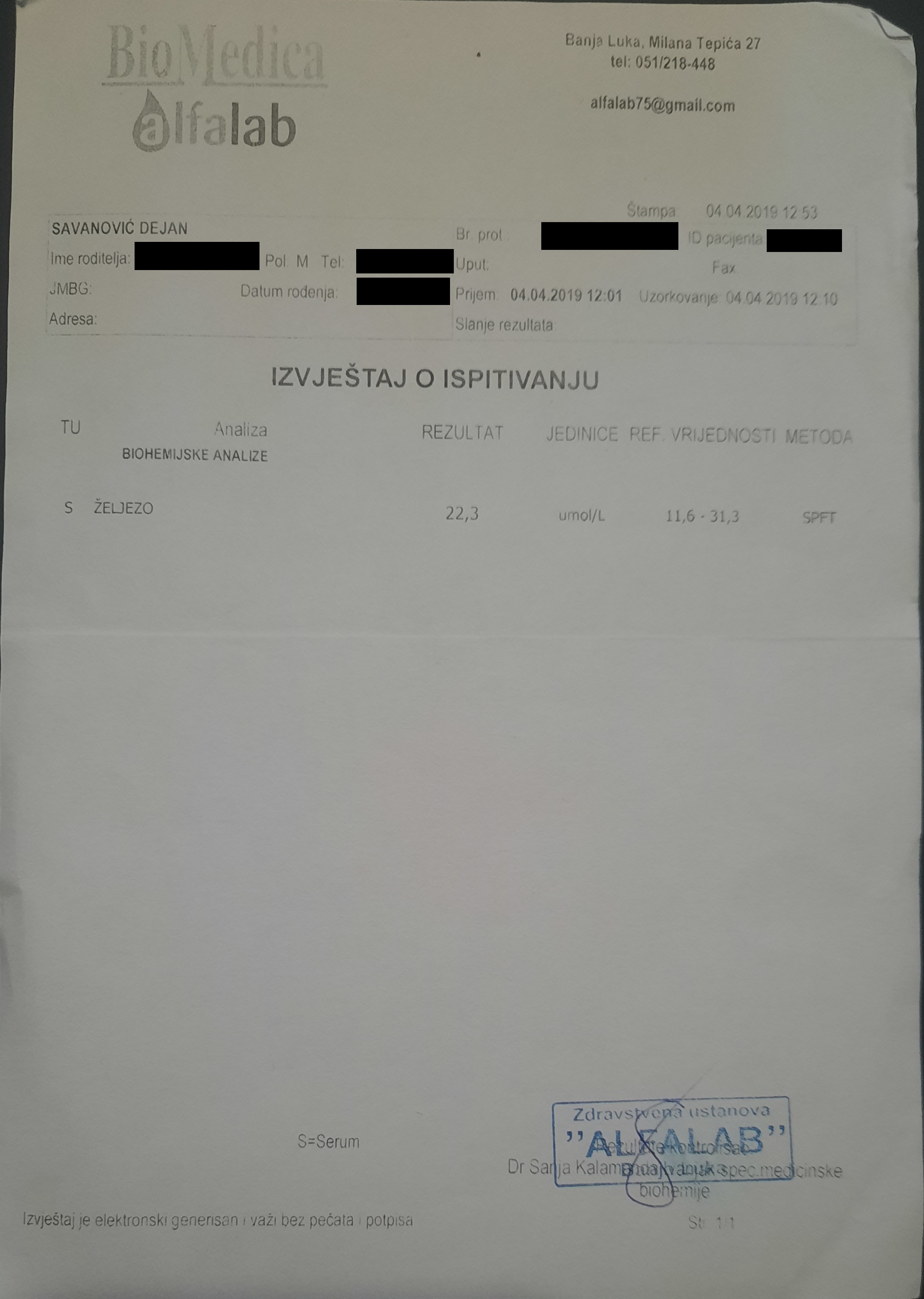
The vodka balloon riddle can be improved once more by tweaking the setup to align with medical standards and by narrowing down the choice of available answers to two, and I have the perfect real-life scenario to do it by. In 2019, I was worried about anemia, so I walked into a lab offering blood tests and asked for a blood iron test. The technician drew my blood, I paid around $20, and I soon got the result. The picture below shows the most relevant part, which is that my blood sample had 22.3 micromoles of iron per liter of blood (click the image for the 939.93 KB, 2,197x3,088px JPG version):
The full version of the photograph reveals that the normal range is 11.6–31.3 micromoles of iron per liter of blood, that the method used is SPFT, and that the results were controlled by a specialist of medical biochemistry. Therefore, my sample was taken and analyzed properly, and my result is in the middle of expected values, so now you are ready for the anemia riddle:
A healthy, middle-aged man scores 22.3 on a blood iron test that used the SPFT method, with the expected values being 11.6–31.3. Is the man in question anemic?
You can ponder the anemia riddle, discuss it with others, or consult the literature or medical professionals, and what I believe you will ultimately conclude is that there is no way to answer it. My blood iron test result is a single data point that on its own means nothing. There needs to be a medical professional who will establish a logical, medically sound diagnosis, and he will order me to do a blood iron test in the course of confirming or disproving that diagnosis.
I was worried about anemia before ordering that test, and I remained worried after getting the test result, and nothing changed except that I was $20 poorer. The test served no purpose, answered nothing, and resolved nothing, and it did not matter that I had a proper medical professional with proper methods take the sample and do the test in a proper lab when I had no idea why I was doing it. Similarly, when a cop orders a blood "alcohol" test done, it does not matter who does the testing or what the result is when he has no idea why he is doing it and there is no medical professional in charge.
We will now look into this mystical word "alcohol" with the goal of dispelling your fear and anxiety of it. You have certainly heard of "alcohol," and you were told it is a dangerous substance, but if you try to discover what an "alcohol" is, you will go down some of the deepest rabbit holes imaginable. I went down a few while researching the origin of the word and unearthed a bizarre mix of science and superstition.
In the past, people were prone to superstition and mob violence, so a scientist had to hide what he was doing from the public by using mysterious terms. That early science was known as "the science from Egypt" aka. alchemy, and it caused much confusion and suspicion, "Is that alchemist trying to find an elixir of immortality? I heard he can talk to spirits to transmute lead into gold." Sometime in the 1560s, the word "alchemist" gave rise to "chemist," which became a legitimate profession that produced useful products, such as glues, paints, solvents, makeup, and so on. Chemists felt validated and free to talk in public without fearing mob violence or the suspicion of consorting with spirits, but they struggled to describe their findings because they sometimes lacked the words to precisely describe a substance, so they would use a vague alchemical term for it.
As chemistry advanced, chemists were discovering more substances than they had names for, and they started wanting to move away from vague alchemical terms by focusing on verifiable science and adopting a transparent system of naming chemicals that invites contributions by anyone and does not cause confusion. I will illustrate this process by comparing the meanings of names of three noble gases discovered by chemists in the 19th and the 20th century within 50 years of each other — helium, argon, and radon — with the various meanings of "alcohol" used over the course of centuries. The source for all four is EtymOnline.com, a website that reveals the origins of English words.
Here is the origin of "helium" (emphasis added):
1868, coined from Greek hēlios "sun" (from PIE root *sawel- "the sun"), because the element was detected in the solar spectrum during the eclipse of Aug. 18, 1868, by English astronomer Sir Joseph N. Lockyer (1836-1920) and English chemist Sir Edward Frankland (1825-1899). It was not actually obtained until 1895; before then it was assumed to be an alkali metal, hence the ending in -ium.
Here is the origin of "argon" (emphasis added):
chemical element, 1894, Modern Latin, from Greek argon, neuter of argos "lazy, idle, not working the ground, living without labor," from a- "without" (see a- (3)) + ergon "work" (from PIE root *werg- "to do"). So called by its discoverers, Baron Rayleigh and Sir William Ramsay, for its inert qualities. They described it as "most astonishingly indifferent."
Finally, the origin of "radon" (emphasis added):
the heaviest gaseous element, short-lived and radioactive, 1918, from German Radon, from radium (q.v.) + -on suffix of inert gases. The element was identified in radioactive decay of radium. Alternative name niton (from Latin nitens "shining") gained currency in France and Germany.
In mere 50 years, chemists went from naming chemicals based on their religious association and assumptions surrounding them to describing what they acted like to literally describing their origin, and that reflected their desire to have efficient communication, but there were still holdovers. We know today that helium is a noble gas, not an alkali metal, but in the periodic table of elements it is in the column with other noble gases while still being marked with the red color reserved for alkali metals, and the old name persists despite being wrong; good luck trying to convince anyone to use the proper name, which would be "helion."
I thought myself educated because I could memorize and repeat the facts about "helium," but now I see that I blindly trusted my chemistry teachers, one of whom wanted to hold me back a year because of my apparent idiocy. She would never have accepted "helion," especially coming from an obviously lazy and stupid student, because her ego was and is too big for correction, and this is a problem with scientists in general. "Helium" is wrong, but the word has become so embedded in the public consciousness that we have no way of dislodging it, and through sheer repetition it has gained undue legitimacy.
Scientists are infamous for being recalcitrant, so any attempt to create an internationally accepted naming scheme for substances had to tread lightly. The Geneva Nomenclature of 1892 was the first attempt to create one such scheme, but the actual naming guidelines appeared only in 1919, when an organization called IUPAC (International Union of Pure and Applied Chemistry) was founded in Switzerland. IUPAC took all the fun out of coining names of substances by proposing guidelines that were based on German grammar rules — the substance name is the literal description of it, and each name can be arbitrarily expanded to infinity, but there are also informal, shortened versions of the name used for convenience. IUPAC did not forcibly correct old names, no matter how misleading they were, and it did not forbid the creation or the use of mysterious names, which allowed troublemakers to out themselves. I expect people with native German proficiency and German citizens to instantly grasp the logic behind that setup.
IUPAC naming guidelines come in several sets that are freely available online, and IUPAC allows their publication by any means as long as they are whole and unchanged, so here is the 2021 issue of one of those sets, the Brief Guide to the Nomenclature of Organic Chemistry (499 KB PDF file). It includes guidelines on naming alcohols in Table 3, stating that their names should always end in "-ol" and that their formula includes something called "-OH." Just like we can recognize noble gases by their names ending in "-on," except helium, we will use the "-ol" and "-OH" rules moving forward to recognize when a substance is very likely to be an alcohol. If you study the rest of IUPAC guidelines, you will learn to decipher the names of substances in everyday products, such as those on the back of a shampoo bottle or on the pack of chewing gum.
Deciphering chemical names helps you understand the world, but it is also your initiation into alchemy, which is made needlessly difficult courtesy of mainstream writers who want to profit off of its mystical aura, such as Dan Brown, a fantasy peddler who is obsessed with the obvious and the material rather than the invisible and the abstract. The goal of alchemists was never hiding clues in paintings and statues for Dan Brown and his fans to discover but transmutation, which means turning one thing into another: leaf into poison, powdered ore into concealing makeup, or lead into gold. The highermost secret of alchemists is that the name of the substance has just as much power as the substance itself, and the same way a substance can transmute the human body, its name can transmute the human spirit.
Consumption of alcoholic drinks transmutes a brave, decent man into a drooling hobo the same way the word "alcohol" transmutes him into a sniveling heap of flesh. It is enough that a cop says "alcohol" to you, and you will throw yourself before his feet, kiss his boots and beg and plead to be protected from this menace, to be tested in any way imaginable, to be put through the gauntlet to prove your innocence and be absolved of the accusation of having consumed it, and to be punished in any way he sees fit. The word itself has transmuted the cop who said it into a power-drunk authority figure, and it transmuted you who heard it and blindly believed it into a meat puppet that can only experience a semblance of happiness when the authority figure is satisfied. To gain autonomy and agency, you would need to learn to scrutinize every word and every substance before use, adopting only those words and those substances that help you transmute into a being that has a soul and can eventually live soulful experiences.
I wrote this text to help people on the path of ensoulment by teaching them to see the name of any substance, the mind that created it, and the mind that is using it as if in the palm of their hand. When you see an acronym that represents a substance, such as CBD, you now know it comes from the alchemical practice of hiding the actual name because of fear of mob violence caused by superstition, and that the creator and the user of the acronym are trying to profit off of the mystical aura behind the acronym. You can look up the full name of CBD and see it is "cannabidiol," which means it is an "alcohol" from the cannabis plant. If someone mentions THC, you can conclude the same, and you can look up its full name to realize it is yet another "alcohol" from the cannabis plant, this time "tetrahydrocannabinol," and that that acronym is also used to obscure the origin of the substance and avoid negative consequences to the speaker.
You can now understand the cannabis scare as well and see how tightly it is interwoven with the "alcohol" scare, and that by challenging the "alcohol" agenda, we can also challenge the cannabis agenda. The reason why cops so ferociously persecute cannabis dealers and users is in all likelihood because of the two alcohols in it, CBD and THC, and the cops neither know nor care about the science or the potential benefits of either. CBD has shown a great deal of promise in stabilizing the brain chemistry in cases of anxiety, epilepsy, and Parkinson's disease, in part thanks to Antonio Waldo Zuardi, a Brazilian psychiatrist who is perhaps the foremost living expert on CBD. He gets treated like a favela bandit by authorities because of his work on CBD, and he does not even have an English Wikipedia article. Other notable CBD experts were Elisaldo Carlini and Raphael Mechoulam, and I invite you to check out their work on cannabis, CBD, and THC.
Your mind is now sufficiently prepared to grasp the full meaning of "alcohol" (emphasis added):
1540s (early 15c. as alcofol), "fine powder produced by sublimation," from Medieval Latin alcohol "powdered ore of antimony," from Arabic al-kuhul "kohl," the fine metallic powder used to darken the eyelids, from kahala "to stain, paint." The al- is the Arabic definite article, "the."
Paracelsus (1493-1541) used the word to refer to a fine powder but also a volatile liquid. By 1670s it was being used in English for "any sublimated substance, the pure spirit of anything," including liquids.
The sense of "intoxicating ingredient in strong liquor" is attested by 1753, short for alcohol of wine, which then was extended to the intoxicating element in fermented liquors. The formerly preferred terms for the substance were rectified spirits or brandy.
In organic chemistry, the word was extended by 1808 to the class of compounds of the same type as this (a 1790 translation of Lavoisier's "Elements of Chemistry" has alkoholic gas for "the combination of alkohol with caloric").
The word "alcohol" predates IUPAC guidelines by a large margin, and therefore, it is not a IUPAC-compliant name for any substance. It is an alchemical term, and just like with "helium," IUPAC allowed everyone to use it in whichever way they chose to reveal who they truly are, and the same way we did with CBD and THC, you can examine the mind of anyone using "alcohol" as if in the palm of your hand to clearly see their intentions. I can use "alcohol" to refer to whatever I want because I am neither a politician nor a cop nor a judge, and my ambiguous use of "alcohol" does not open the door to my abuse of authority because I have none, but when any of them use the word "alcohol" to refer to an unknown substance that is detected by unknown means, they are using a mysterious alchemical word to turn their texts into alchemical texts that can mean anything and be used for total control.
When a cop says "alcohol" to refer to "intoxicating ingredient in strong liquor," he is using the 1753–1808 meaning of the word in an attempt to invoke the alchemical principle of transmutation and transmute you into a meat puppet, and if you blindly believe him, you will become one. If you adopt a scientific mindset, you will immediately recognize him as a fantasy peddler trying to profit off of the alchemical aura of mysticism, you will see in front of you a stupid and lazy person who blindly believes authorities, and you will stubbornly refuse to believe a single word he is saying to you. The word "alcohol" is still used in chemistry, but it means little, and it is akin to mentioning a loosely related category of things, such as "stone," and there is actually one "alcohol" that I will describe later that can turn into stone.
That outdated meaning of "alcohol" has embedded itself in the worldwide police, judicial, legislative, and media centers of power, where it gained a life of its own and persists through dogmatic education for a simple reason — authority figures can overstep their boundaries and destroy anyone they want under the excuse of fighting the overwhelming and omnipresent danger of "alcohol." Anyone can be made into a target for character assassination and mob violence by claiming the target has taken "alcohol" or is an alcoholic, and there is no defense against that accusation because alcohols are a part of life. Even supposedly intelligent people in positions of power talk about "alcohol" without understanding what it is, and yet, if there is only a glimpse of the man behind the curtain, they are revealed for what they are and the entire scam is undone.
The definition of "alcohol" has been updated since 1808 because chemistry has advanced and chemists gained the ability to see the substance while it is sitting still or while it is reacting with other substances, which revealed its structure, its behavior, and the connection between the two. If we take a look at the Wikipedia article "Alcohol (chemistry)," we will read that modern chemistry currently defines "alcohol" as an:
organic compound that carries at least one hydroxyl (−OH) functional group bound to a saturated carbon atom
That definition lines up with the IUPAC guidelines found above that mention "-OH," but it is not of much help. My understanding of it is that substances are like Lego blocks made up of small pieces that are like Lego pieces. Each Lego piece gives a certain quality to the entire block, and there is a special Lego piece called "the -OH functional group" that gives the block an alcohol-y nature, meaning the substance easily evaporates and serves as a solvent. All alcohols have it, but so do some sugars, and some fats might have it as well, so alcoholiness is a sliding scale rather than a clear distinction. Therein lies the problem because the -OH functional group is in many chemicals inside and outside the human body, and it is hard to tell which of them and under what circumstances can cause a false positive on a breathalyzer or a blood "alcohol" test.
Depending on where the -OH functional group is and how it connects to other pieces, it has a stronger effect on the entire Lego block, which then becomes more or less alcohol-y, sugar-y, or fat-ty, and that also changes with the size of the block and positions and orientations of other pieces. Be warned that researching this on your own may lead you to life-changing discoveries about your dietary habits and your health. It may turn out that an unassuming snack you have been eating your entire life is actually a fatty substance that is as toxic to your body as "alcohol." You can stop eating that snack and heal yourself, but you would not be able to conclusively prove how that fatty substance acts inside the human body because scientists who can typically get a Nobel Prize for their work, which goes to show just how wicked it is to accuse someone of "alcohol" consumption — the burden of proof is placed on the accused, who has to do life-changing, Nobel Prize-worthy research to prove his innocence.
Why the -OH functional group matters in our daily life is that we can eat and drink alcohols, sugars, and fats, and they are typically dealt with by common pathways in the liver, which also deals with poisons. Without going too much into it, this already indicates that, if a liver is burdened with processing fats or sugars because of a poor diet or because the person is poisoned, it might not be as equipped to handle alcohols and that person might have more "alcohol" in the blood, with or without alcoholic drink consumption. I got an accidental confirmation of this in 2019 during my liver ultrasound, which showed a brighter liver than expected. The performing intern told me to go easy on liquor, which was difficult for me because I was not drinking any, and I was maybe drinking a can of beer a week. I proposed that the liver change was due to all the sugar and fat I was eating, and the doctor agreed.
Damage to the liver usually shows up as fat deposits inside the liver, and this is known as "fatty liver disease," which used to have two subtypes: alcoholic fatty liver disease and non-alcoholic fatty liver disease. Now I see that Wikipedia has renamed the latter to "Metabolic dysfunction–associated steatotic liver disease," and in the eponymous article it reads (emphasis added):
Metabolic dysfunction–associated steatotic liver disease (MASLD), previously known as non-alcoholic fatty liver disease (NAFLD), is a type of chronic liver disease. This condition is diagnosed when there is excessive fat build-up in the liver (hepatic steatosis), and at least one metabolic risk factor. (...) The terms non-alcoholic fatty liver (NAFL) and non-alcoholic steatohepatitis (NASH, now known as metabolic dysfunction associated steatohepatitis, MASH) have been used to describe different severities, the latter indicating the presence of further liver inflammation.
Treatment for MASLD is weight loss by dietary changes and exercise (...)
MASLD is the most common liver disorder in the world; about 25–38% of people have it, and the prevalence is rising. It is very common in developed nations, such as the United States, and affected about 75 to 100 million Americans in 2017.
Disruptions in the intestinal microbiota seem to influence MASLD risk in several ways. People with MASH can have elevated levels of blood ethanol and Pseudomonadota (which produce alcohol), with dysbiosis proposed as a mechanism for this elevation.
Liver function tests may be abnormal, but they often remain within the normal range even in advanced disease. Other blood tests that may be useful to confirm the diagnosis (...)
When the liver can no longer contain the damage, the human body will store the fat outside the liver, usually around the waist and the thighs. If you ever wondered why it is so difficult to lose weight no matter how much you exercise, it is because your fat deposits might be an indication of liver damage, and until your liver regenerates itself, you might just have to suffer the excess weight. Until your liver restores its normal function, you might end up positive on a breathalyzer or blood "alcohol" test without consuming any alcoholic drinks.
For me, the snack that was destroying my liver and my "alcohol" were sunflower seeds. I did not think much of them until I watched Chris Knobbe's lectures on dietary fats and seed oils. When I also read Ray Peat's article "Toxicity of Stored PUFA," where he wrote that certain unsaturated fats are not nutritious to the human body and damage the liver and that it takes 600 days for the liver to remove half of those toxic fats from the body, I knew I had to try eliminating sunflower from my diet. In November 2021, I stopped consuming sunflower seeds and sunflower oils and switched over to lard, olive oil, and coconut oil. My expectation was that 600 days later I will experience some weight loss, but what happened exceeded my expectations.
By July 2023, I had lost 13 kilograms of body weight, and by October 2026, I lost an additional 7 kilograms, which perfectly aligns with Ray Peat's prediction. I weighed myself at random times during the day, and the most drastic change was after sleep, for which I have no explanation other than that my liver was converting the stored toxic fats in my body into gases that I was exhaling. In the morning, I would release an unusually large volume of urine that was disproportionate to how much water I had been drinking, and when I looked at how fats are processed in the body, I realized they are converted into CO2 and H2O, and it all made sense. I am now actually anxious about losing too much weight because the ease with which my body sheds excess weight is honestly frightening.
Something you consume can be harmless to others but be your "alcohol," or it can be just an irritant depending on your genetics, your health, whether you are poisoned, and so on. Glycerol is the perfect example of what we are dealing with because it seems to be an alcohol, a fat, and a sugar at the same time. The Wikipedia article "Glycerol" states (emphasis added):
Glycerol is a sugar alcohol (...), a colorless, odorless, sweet-tasting, viscous liquid. (...) The glycerol backbone is found in lipids known as glycerides (...) Typical plant sources include soybeans or palm. Animal-derived tallow is another source.(...) Taken rectally, glycerol functions as a laxative by irritating the anal mucosa.
If you visit your doctor, he might order you to take a blood test to check your triglyceride levels.
"Glycerol" is one of the pre-IUPAC names that is still in widespread use today. Its IUPAC name literally describes its structure, which is a 3-carbon gas, propane, with each carbon atom having its own -OH functional group, and Wikipedia says it is:
propane-1,2,3-triol
You can see how clean and neat the IUPAC naming system is because you can reconstruct the chemical by writing out the structure of propane and attaching -OH groups to its carbon atoms. We can now look at other, more complex chemicals and their names, which can sometimes be barely human parsable, but we can focus on just one segment of a name. Let us take for example the anti-diabetes medication sold under the brand name "canagliflozin" and focus on the ending of its IUPAC name, which Wikipedia lists as (emphasis added):
(1S)-1,5-anhydro-1-C-(3-{[5-(4-fluorophenyl)thiophen-2-yl]methyl]}-4-methylphenyl)-D-glucitol
Glucitol is an "alcohol" embedded inside canagliflozin, which is the kind of medication that changes the way kidneys work by making the body pee out more sugar than it normally would, which can help lower blood sugar without waiting for the liver. It is prescribed by a doctor who will establish the baseline of sugar in the patient's urine, analyze the patient's medical history to see if canagliflozin is the right choice, and check the patient's urine after canagliflozin to see if it is working. It is logical that, if the patient's urine has more sugar after canagliflozin than before, the medication is working and there is less sugar inside the patient's body. This is another confirmation that breathalyzers operate on a faulty premise that is the exact opposite of the premise doctors use with their patients.
Doctors do not randomly test their patients because that is meaningless, it tortures the patient, it is a waste of time and money, it can result in a false positive diagnosis, and it can lead to a malpractice lawsuit. The test has to make sense from the medical standpoint, it needs to be a part of a logical course of action that involves the medical treatment of the patient with a specific goal in mind, and there needs to be a qualified healthcare provider to keep track of the patient's medical history and determine which test should be done, when, and why, and the entire process requires the continued, willing involvement of the patient. A doctor must be able to explain why he ordered the test he did, but cops can ignore all those requirements — they just randomly test whoever they want, they cannot be sued for malpractice because they are not healthcare providers, and they do not have to explain anything to anyone.
Cops do not keep track of anyone's medical history nor do they have access to it to find the baseline of "alcohol" for each person, and they do not care. They do not know if the person is taking any medication that could cause a false positive, and they do not care. They do not know if there is an underlying health condition that could cause a false positive and they, shockingly enough, do not care. They do not know if the sample or the environment or the testing device have been contaminated, and they do not care. They just randomly stop a person, propose to do a random "alcohol" test because there is some law authorizing them to do it, and try to find any justification to determine that the test subject is "drunk" because they have to meet their DUI quota, and if they do not, they will get kicked off the squad and replaced by another power-drunk petty tyrant that will.
The IUPAC guidelines allowed scientists to collaborate on an unprecedented level without falling victim to charismatic scientists using mysterious terms for personal gain. We have an extraordinary record of those collaborations in Nobel Prize press releases, which reveal how scientists from all the world put previously unrelated substances, phenomena, and processes in direct connection. Let us choose one substance, such as cholesterol, and see how much our understanding of it and its importance in the human body changed in one century.
In 1928, Adolf Otto Reinhold Windaus won the Nobel Prize in chemistry for his work on a group of substances called "sterols" and their relation to vitamins, especially vitamin D. The Nobel Prize website's page titled "Speed read: Connecting vital functions" explains that some biological processes seem worlds apart but are chemically similar by stating (emphasis added):
The key link in all these processes is a series of chemicals found widely in animals, plants and vegetables called sterols, of which the best known is cholesterol. Correctly believing that all sterols are derived from a parent substance, Windaus isolated digestive chemicals formed in the liver called bile acids, and showed that they are closely related to the sterols by successfully transforming cholesterol into one of these bile acids, cholanic acid. Windaus found the same to be true for several of the cardiotoxic compounds derived from the foxglove plant.
In perhaps his best-known achievement, Windaus discovered that the chemical precursor of vitamin D is also a member of the sterol group, and he showed how sunlight breaks one of the chemical bonds in the parent molecule, converting it into the active vitamin. The finding had major implications outside of chemistry; it revealed why exposure to sunlight can prevent rickets, a disease caused by vitamin D deficiency in humans.
The presentation speech was given by Professor H.G. Söderbaum and in part reads (emphasis added):
The so-called sterols are also an extremely interesting group from the physiological viewpoint. They too occur both in vegetation and in animals. Most numerous are the vegetable sterols, the so-called phytosterols, but the best-known is certainly cholesterol, which occurs in the animal organism, and which was first found about 150 years ago in gall stones. This substance occurs not only in bile but also in the brain, in nerve substance, in the egg, in blood, and presumably in all cells. Thus we can conclude that it plays an extremely important part in the life process of man and the animals, just as the phytosterols play an extremely important part in the life process of plants.
In 1964, Konrad Bloch and Feodor Lynen jointly won the Nobel Prize in Physiology or Medicine for their discoveries related to cholesterol. Their findings were in part summarized by Professor S. Bergström thusly (emphasis added):
The word cholesterol means gallstone and the reason for this name is that cholesterol was isolated almost 200 years ago from human gallstones. Another connection between cholesterol and human diseases has been established more recently. During the last decade there has been a lively discussion, also in the newspapers, about the correlation between atherosclerosis and the amount of cholesterol and other fats in diet and in blood. This discussion has perhaps concealed from many the fact that cholesterol is a necessary constituent of all our cells and that it fulfils important functions.
At an early stage Bloch made another discovery of fundamental importance in showing that cholesterol is the precursor of bile acids and of one of the female sex hormones. These discoveries opened up a new field of research that has engaged a great number of scientists in different disciplines. We know now that all substances of steroid nature in our body are formed from cholesterol.
In 1985, Michael Brown and Joseph Goldstein jointly won the Nobel Prize in Physiology or Medicine for their discoveries related to cholesterol and atherosclerosis, the disease caused by its accumulation inside the blood vessels. In short, the two discovered the existence of cholesterol receptors on the surface of cells in the body, and they discovered that some people lack these receptors, causing them to accumulate cholesterol in blood, especially if their cholesterol intake is higher than they can process. The Nobel Assembly press release for their discovery states in part that (emphasis added):
The cholesterol debate during the last decade may have given the public the impression that cholesterol is something you have to avoid to survive. This is, however, neither possible nor desirable: cholesterol is present in all our tissues and is produced in the body. Cholesterol is also vitally important for several of the normal processes in the body.
The research of cholesterol continued into the 21st century. A 2008 study titled "Cholesterol: a Century of Research and Debate" stated that cholesterol is the most highly decorated molecule in history and that a total of 13 Nobel Prizes have been awarded because of discoveries related to cholesterol. A 2009 study titled "Special relationship between sterols and oxygen: were sterols an adaptation to aerobic life?" mentions Konrad Bloch's work and offers the idea that sterols first appeared in living organisms when oxygen became abundant in the Earth's atmosphere and that sterols are a way to defend against oxygen's reactivity.
None of that would be problematic except that sterols are alcohols, and cholesterol, being a sterol, is also an "alcohol," which we are told is a dangerous, prohibited substance and the consumption of which is allegedly determined by the use of breathalyzers and blood alcohol tests. It is important to note that cholesterol is a big Lego block and that its -OH functional group is small, which means cholesterol is a fat-ty substance rather than an alcohol-y one, but it is an "alcohol," and we do not know if and under which circumstances cholesterol can trigger a false positive on a breathalyzer or a blood alcohol test.
EtymOnline says the following about "cholesterol" (emphasis added):
white, solid substance present in body tissues, 1894, earlier cholesterin, from French cholestrine (Chevreul, 1827), from Latinized form of Greek khole "bile" (from PIE root *ghel- (2) "to shine," with derivatives denoting "green, yellow," and thus "bile, gall") + steros "solid, stiff" (from PIE root *ster- (1) "stiff"). So called because originally found in gallstones (Conradi, 1775). The name was changed to the modern form (with chemical suffix -ol, denoting an alcohol) after the compound was discovered to be a secondary alcohol.
Chemical names typically stay the same, but cholesterol is an exception; the new name got so much publicity through Nobel Prize press releases that the update was inevitable. However, in Germany the old name "das Cholesterin" is still used. Cholesterol also has a simple IUPAC name that briefly describes its structure:
Cholest-5-en-3β-ol
and a complex IUPAC name that goes full German:
(1R,3aS,3bS,7S,9aR,9bS,11aR)-9a,11a-Dimethyl-1-[(2R)-6-methylheptan-2-yl]-2,3,3a,3b,4,6,7,8,9,9a,9b,10,11,11a-tetradecahydro-1H-cyclopenta[a]phenanthren-7-ol
We can use any of its three names to refer to cholesterol, but we cannot use "sterol" or "alcohol" to refer to it because those two words represent categories of substances. Therefore, we have no idea what a law that mentions "alcohol" is referring to, and it could be referring to cholesterol as well as a myriad of other substances. If I were a tyrant who wanted to genocide his people by enacting a law that banned cholesterol, they would immediately see me for who I am because cholesterol is necessary for life, but if I enacted a law that banned "alcohol" while propagating the idea that "alcohol" is harmful, I would appear to be a legitimate protector of the public while being tyrannical because that law would sneakily also ban cholesterol without anyone realizing it. Thanks to the existence of one such law, I would be able to do any tyrannical act to anyone and get away with it thanks to the veneer of legitimacy provided by that law.
In my opinion, the mere presence of the word "alcohol" in any law makes that law a tyrannical, genocidal act and should be grounds for automatic annulment of that law and permanent removal from office of anyone trying to enact or enforce that law. If a legislative body wants to ban a specific substance, it should use the substance's proper name, and if it does not, it is trying to give a broader scope to the law than is necessary, and the only reason is that the body wants to gain tyrannical power while profiting off the alchemical aura of mysticism.
Work on cholesterol inspired further chemical research into the origin of life, which revealed life-giving substances called "vitamins"; people who discovered a vitamin typically got a Nobel Prize for their work. You already saw that cholesterol is an "alcohol" that is transformed by sunlight into vitamin D, but there are other vitamins that are also related to alcohols or that have an alcohol form that the body prefers because that makes them easier to move around. Here are the Wikipedia descriptions of some vitamins; note the casual admissions that they are "alcohol," which means that a law that bans "alcohol" also bans these vitamins (emphasis added):
The Wikipedia article "Retinol" states (emphasis added):
IUPAC NAME: (2E,4E,6E,8E)-3,7-dimethyl-9-(2,6,6-trimethylcyclohex-1-en-1-yl)nona-2,4,6,8-tetraen-1-ol
(...) Retinol is a hydrolytic metabolite of retinyl esters belonging to the group of vitamin A1 as an alcohol form. (...) Dietary sources include fish, dairy products, and meat.
(...) Liver cells store vitamin A as the ester, and when retinol is needed in other tissues, it is de-esterifed and released into the blood as the alcohol. Retinol then attaches to a serum carrier, retinol binding protein, for transport to target tissues.
(...) Retinol or other forms of vitamin A are needed for eyesight, maintenance of the skin, and human development. (...) Vitamin A is involved in maintaining a number of immune cell types from both the innate and acquired immune systems. (...) Deficiencies in vitamin A and retinoic acid have been linked to an increased susceptibility to skin infection and inflammation. (...) Vitamin A is needed to produce the red blood cells from stem cells through retinoid differentiation.
(...) In 1912, Frederick Gowland Hopkins demonstrated that unknown accessory factors found in milk, other than carbohydrates, proteins, and fats were necessary for growth in rats. Hopkins received a Nobel Prize for this discovery in 1929. (...) In 1967, George Wald was a co-recipient of the Nobel Prize in Physiology and Medicine "for their discoveries concerning the primary physiological and chemical visual processes in the eye."(...)
In 2018, I visited a dermatologist for a rash, and she recommended a daily nourishing skincare routine that included panthenol. It turns out panthenol is a common ingredient in skincare products, and the skin drinks it up as soon as you put it on. You can literally bathe in panthenol by using shampoos with panthenol, and your body will never have enough of it. Now let us see what Wikipedia says about it in the article "Panthenol" (emphasis added):
Panthenol (also called pantothenol) is the alcohol analog of pantothenic acid (vitamin B5), and is thus a provitamin of B5. In organisms, it is quickly oxidized to pantothenic acid. It is a viscous transparent liquid at room temperature. Panthenol is used in pharmaceutical and children's products as a moisturizer and to hasten wound healing.
Panthenol comes in two enantiomers: D and L. Only D-panthenol (dexpanthenol) is biologically active, however both forms have moisturizing properties. For cosmetic use, panthenol comes either in D form, or as a racemic mixture of D and L (DL-panthenol).
MyHealthcare.com has a page titled "Vitamin B5: History and Discovery," where we can read the following on the name:
In 1933, a chemist at Oregon State College named Roger J. Williams announced that he had found an acidic substance that yeast could not grow without — and that the same substance turned up in nearly every living thing he tested. He gave it a name built from the Greek word for "everywhere," pantothen, and called it pantothenic acid. That single naming choice is the spine of this vitamin's history: it really is everywhere (...)
A 2021 South Korean study titled "Dexpanthenol Promotes Cell Growth by Preventing Cell Senescence and Apoptosis in Cultured Human Hair Follicle Cells" discusses the effects of dexpanthenol on hair loss and finds that:
In conclusion, our data suggest that the hair growth stimulating activity of D-panthenol was exerted by increasing the cell viability, suppressing the apoptotic markers, and elongating the anagen phase in hair follicles. (...) Our data demonstrate that D-panthenol could promote hair growth (...)
"Apoptosis" means "self-destruction" and "anagen" means "growth," so dexpanthenol made the hair grow longer and delayed its death. The authors of the study note that panthenol was long used in anti-hair loss products, but the mechanism of action was poorly understood. Finally, they say that the benefits of it apply to both men and women.
What we know as vitamin D is actually a collection of substances derived from cholesterol. The Wikipedia article "Cholecalciferol" says this about them (emphasis added):
IUPAC name: (3S,5Z,7E)-9,10-secocholesta-5,7,10(19)-trien-3-ol
Cholecalciferol is synthesised in the skin following sunlight exposure. It is then converted in the liver to calcifediol (25-hydroxycholecalciferol D), which is further converted in the kidney to calcitriol.
The action of calcitriol is mediated by the vitamin D receptor, a nuclear receptor which regulates the synthesis of hundreds of proteins and is present in virtually every cell in the body.
The Wikipedia article "Tocopherol" states (emphasis added):
(...) Because the vitamin activity was first identified in 1936 from a dietary fertility factor in rats, it was named tocopherol, from Greek τόκος tókos 'birth' and φέρειν phérein 'to bear or carry', that is 'to carry a pregnancy', with the ending -ol signifying its status as a chemical alcohol. (...)
Vitamin E exists in eight different forms, four tocopherols and four tocotrienols. (...) Each form has a different biological activity. (...)
α-Tocopherol is the form of vitamin E that is preferentially absorbed and accumulated in humans. It is also the most bioactive form of tocopherol. The measurement of "vitamin E" activity in international units (IU) was based on fertility enhancement by the prevention of miscarriages in pregnant rats relative to α-tocopherol. (...)
Swiss chemist Paul Karrer got half of the 1937 Nobel Prize in Chemistry thanks to his work on creating vitamin E in the lab, as shown on "The Nobel Prize and the discovery of vitamins" webpage of the Nobel Prize website. The presentation speech for that Nobel Prize does not explicitly mention vitamin E, instead stating, "The structure of a second vitamin has also been cleared up, thus enabling its technical preparation."
To recap: a waxy substance known as cholesterol that can turn into stone in the gallbladder turns into cholecalciferol in the skin when exposed to sunlight, and then it travels to the liver, where it becomes a different alcohol, and then travels to the kidneys, where it becomes yet another alcohol and eventually attaches to vitamin D receptors. How does any of that make any sense? Yet, it is undeniably true and reveals just how weird the human body is. Any random factor can throw off any of the million small processes in the body out of whack and cause a false positive on an "alcohol" test, and the cops will absolutely not care if and why the false positive happened; they only care about bumping up their arrest stats because their superior's budget depends on those stats.
To accuse people of having consumed "alcohol" and to persecute them because they have "alcohol" in their breath or blood or body is opposed to science, logic, and medicine, and it is genuinely anti-human. Nobody can enforce a law or an order that regulates or bans the presence of alcohols in the human body while justifying it with "I was just following orders" or "that's the law" or "I'm too stupid to realize I'm doing harm," which is the so-called "Nuremberg defense" used by NSDAP officers after World War II. It was not accepted then, and it should not be accepted now.
Alcohols can turn to stone or nourish the body, but they can also be poisons that incapacitate the body. One such alcohol with a toxic, numbing effect is called "ethanol," and when lawmakers enact a law banning "alcohol," they are most likely justifying the law because of the toxic effects of ethanol, which is present in alcoholic drinks, such as vodka and tequila. There is nothing magical about ethanol — it is a naturally occurring alcohol that happens to put mammals in a state of relaxation, numbness, and sleep. How much ethanol it takes to relax, numb, or lull a mammal depends on many factors, including body weight, age, and whether the stomach was full. EtymOnline says for "ethanol":
"ethyl alcohol," 1900, contracted from ethane, to which it is the corresponding alcohol, + -ol, here indicating alcohol.
Wikipedia's article "Ethanol" describes it as (emphasis added):
Ethanol is naturally produced by the fermentation process of sugars by yeasts or via petrochemical processes such as ethylene hydration. Historically it was used as a general anesthetic, and has modern medical applications as an antiseptic, disinfectant, solvent for some medications, and antidote for methanol poisoning and ethylene glycol poisoning. It is used as a chemical solvent and in the synthesis of organic compounds, and as a fuel source for lamps, stoves, and internal combustion engines. Ethanol also can be dehydrated to make ethylene, an important chemical feedstock.
(...) Ethanol can commonly be found in overripe fruit.(...) Ethanol has been detected in outer space, forming an icy coating around dust grains in interstellar clouds. Minute quantity amounts (average 196 ppb) of endogenous ethanol and acetaldehyde were found in the exhaled breath of healthy volunteers. Auto-brewery syndrome, also known as gut fermentation syndrome, is a rare medical condition in which intoxicating quantities of ethanol are produced through endogenous fermentation within the digestive system.
Ethanol is surrounded by much negativity because it is apparently a cause of violent behavior, yet it is a crucial part of life processes that happen 24/7. For example, ripening fruit produces ethanol, and as the fruit starts to rot, this ethanol turns into ethylene, a plant hormone that is a colorless and odorless gas. When this gas comes into contact with certain other fruits and vegetables, it causes them to ripen as well, meaning they too produce ethanol, which transforms into ethylene, and so on. Thanks to its ability to transform into a gas and back into itself, ethanol can apparate in fruits, and that process has probably been happening since the appearance of plants. That explains why you can place a single bruised apple in a bowl of perfectly fine apples and by the next morning discover a bowl of slimy, rotting apples.
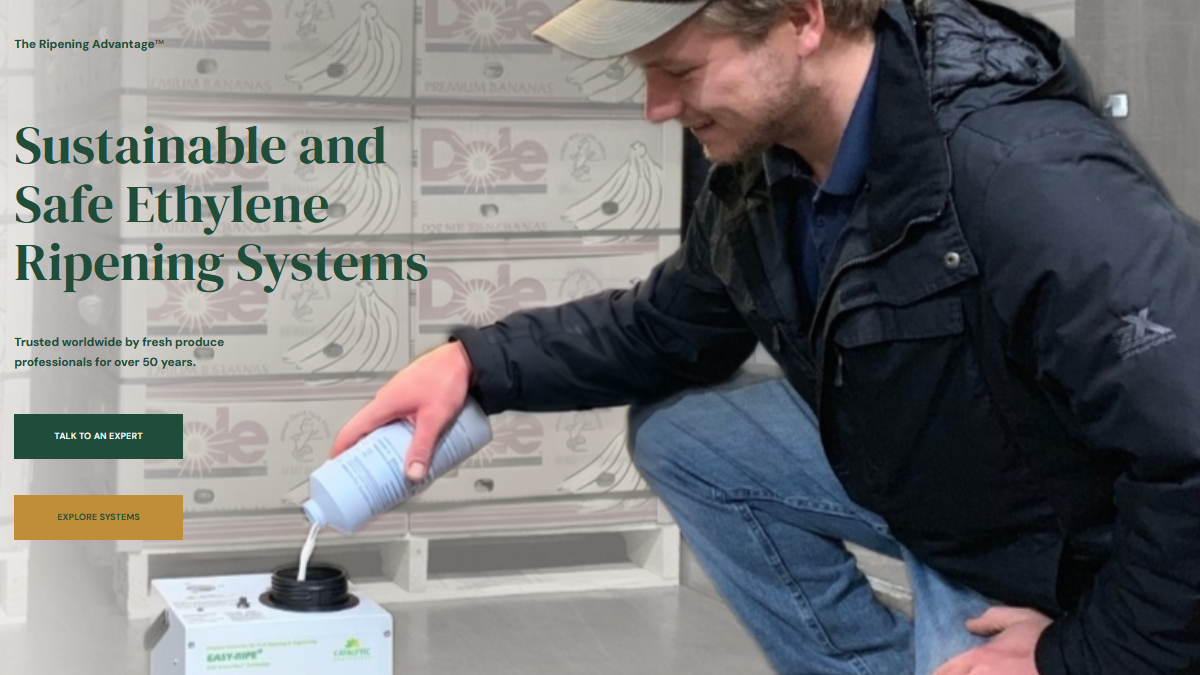
This cycling of ethylene and ethanol is commercially significant to farmers, who were the first to discover the connection. They placed kerosene lamps next to their produce, and they eventually realized that the lamps somehow triggered the ripening reaction, and that was later confirmed in the lab — burning jet fuel indeed creates a plant hormone, which is a counterintuitive reaction but is real. Modern farmers use ethylene generators next to unripe produce to transmute its appearance into seemingly ripe, which lets them rush the harvest and sell worthless produce with little nutritive value at a premium price. Here is one ethylene ripening system in action next to crates of Cavendish bananas, which are picked unripe so that they survive the transport (click the picture for the 1.3 MB, 1200 x 675px version):
Does an overripe banana have ethanol then? I do not know for sure, but I believe it does, and I am pretty sure an overripe pineapple does as well. Whenever I have tasted one such pineapple, I tasted the distinct acidic mouthfeel of ethanol, though I have not tested this with tools to any degree of scientific confidence.
It is worth noting just how little it takes for ethanol to appear. For example, yeast eats "sugar" and produces ethanol. When you make bread using yeast, the bread will have holes, which are because the yeast consumes "sugar" in the dough to produce ethanol and CO2, a gas that creates those pockets. I find it interesting that Jews eat unleavened bread (matzo), meaning bread without yeast, during Passover, and now it makes sense; some rabbi noticed that bread with yeast causes erratic behavior and decided to ban a certain kind of food through a religious edict, but if you were to ask the Jews why they eat matzo, they would probably be unable to explain it. Secular laws that ban "alcohol" act in pretty much the same way.
Based on everything we learned about ethanol, it would make sense that cops would be using breathalyzers and blood "alcohol" tests to confirm ethanol consumption and/or ethanol presence in the test subject's body, except that there is no indication of that at all. I have yet to find any mention of "ethanol" in connection with breathalyzers or blood alcohol tests; it is always "alcohol," and when I looked through one of the US laws concerning breathalyzers, the only mentions of ethanol were in relation to fuels, not drinkables. I believe the conclusion is logical — lawmakers refer to "alcohol" to maximize the abuse of authority, and they all know that it is a scam.
When a cop tells you that you will undergo "blood alcohol testing," that is an admission of the scam. The proper name for any such testing should be "blood ethanol testing" because ethanol is the one alcohol that is provably incapacitating, but since ethanol likely changes inside the body and produces all kinds of other chemicals as the body is trying to metabolize it, an even more proper name for such testing would be "blood ethanol and metabolite testing," and even then, one such test could be positive to anything depending on how it is calibrated. In any case, agreeing to a mysterious test means agreement to a cookie riddle-like scenario, and if you agree to it, in my opinion, you are a mindbroken slave, and in the opinion of crazed tyrants ruling over us, you fully deserve whichever punishment you receive.
Yeast is a primitive organism, but it can turn "sugar" into ethanol, which means there should be some overlap between "sugar" and "alcohol," and that is exactly the case. Sugars aka. carbohydrates are an infinitely large category of substances to the point the word "sugar" is meaningless, just like "alcohol," and there are indeed plenty of so-called "sugar alcohols," which have properties of both sugars and alcohols. They are used in candy as a supposedly healthy substitute for the table sugar, sucrose, because they are low in calories, but there is a snake in that box of chocolates — the human body struggles to digest them and finds them irritating, so they just slither through the gut and strip away the friendly bacteria. The image below shows the ingredient list of Airwaves Black Menthol chewing gum with several sugar alcohols and a diarrhea warning in French (click the image for a 756.92 KB, 2,801x955px JPG version):
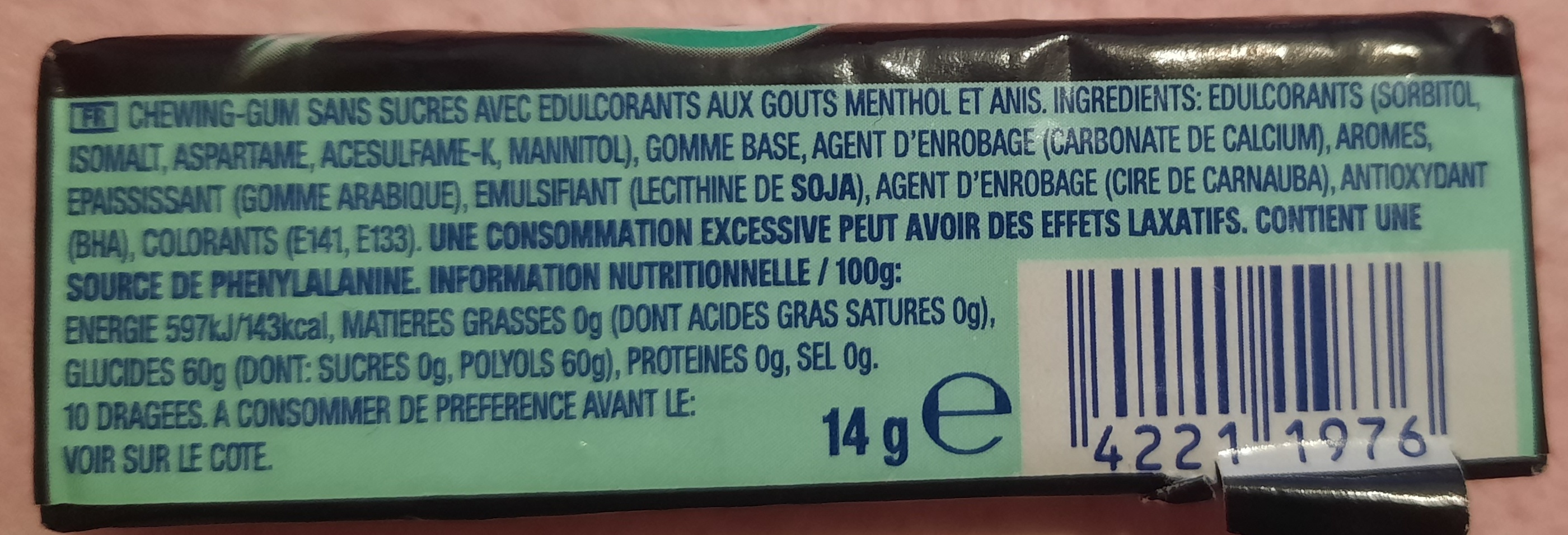
The ingredient list shows the following sugar alcohols:
The chewing gum contains a hidden sugar "alcohol" that is not in the ingredient list. Have you spotted it yet? By now, you should be spotting alcohols left and right, but if not, keep reading, and you will find it mentioned after the three listed above. Here are the most interesting parts from Wikipedia articles on all four (emphasis added):
Sorbitol — less commonly known as glucitol, is a sugar alcohol with a sweet taste which the human body metabolizes slowly.(...) Most sorbitol is made from potato starch, but it is also found in nature, for example in apples, pears, peaches, and prunes. (...) Sorbitol is an isomer of mannitol, another sugar alcohol; the two differ only in the orientation of the hydroxyl group on carbon 2. While similar, the two sugar alcohols have very different sources in nature, melting points, and uses. (...) Too much sorbitol trapped in retinal cells, the cells of the lens, and the Schwann cells that myelinate peripheral nerves, is a frequent result of long-term hyperglycemia that accompanies poorly controlled diabetes. This can damage these cells, leading to retinopathy, cataracts and peripheral neuropathy, respectively.
Isomalt — like most sugar alcohols (including the chemically similar maltitol), isomalt carries a risk of intestinal distress when consumed in large quantities (above about 20–30 g per day). Isomalt may prove upsetting to the intestinal tract because it is incompletely absorbed in the small intestine, and when polyols pass into the large intestine, they can cause osmotically induced diarrhea and stimulate the gut flora, causing flatulence. As with dietary fibers, regular consumption of isomalt can lead to desensitization, decreasing the risk of intestinal upset.
Mannitol — a type of sugar alcohol used as a sweetener and medication. It is used as a low-calorie sweetener as it is poorly absorbed by the intestines. As a medication, it is used to decrease pressure in the eyes(...) Mannitol is a natural constituent of most microorganisms and plants, having an essential role in maintaining cell and tissue water balance, and responding to environmental stresses, such as drought or low temperature.
Menthol — organic compound that occurs naturally in the oils of certain plants in the mint family, such as corn mint and peppermint. It is a white or clear waxy crystalline substance that is solid at room temperature and melts slightly above. (...) Commonly used in oral hygiene products and bad-breath remedies, such as mouthwash, toothpaste, mouth and tongue sprays, and more generally as a food flavor agent; such as in chewing gum and candy. (...) Menthol reacts in many ways like a normal secondary alcohol.
Airwaves Black Menthol is an alchemical experiment masquerading as candy, and by consuming it, you are undergoing transmutation into a human with gut stripped of helpful bacteria that you got with birth and that are difficult to replenish. My research showed that low-sugar yogurt, especially of the probiotic variety, can help if consumed daily.
Before consuming any candy, make sure to check the ingredient list. I previously showed you how to recognize "alcohol," and now you are aware that they can be sugar alcohols, which irritate the gut. There are sugar alcohols that might have a positive health impact, such as xylitol, a "sugar alcohol" extracted from birch that might help clean the mouth from bacteria, and I suppose chewing a gum with xylitol might help if you keep spitting out instead of swallowing the resulting saliva, but I would stay away from any candy with sugar alcohols.
Would chewing Airwaves Black Menthol produce a false positive on the breathalyzer? Presumably yes, and there appear to be common foods that can also produce a false positive, which is why breathalyzers are a closely guarded product that you cannot obtain as an individual. But, on the rarest of occasions, we have cops themselves marveling at how a breathalyzer works and revealing to us how easily it produces false positives.
The human body can instantly produce substances that trigger a false positive breathalyzer reading, as seen in the following video. It was filmed in a South African police station by two cops, one of whom, Mr. Williams, used a breathalyzer before and after he ate a few bites of a Traditional Hot Cross Bun, which triggered a false positive reading of 0.21 (5.36 MB WEBM, 1m51s duration, original resolution 220x400):
My best guess is that the false positive was due to the bacteria in Mr. Williams' mouth processing the dough and producing ethanol or a similar substance. Saliva pre-digests food, and in the case of store-sold pastry, which consists of processed flour that is easy to chew, that melts in the mouth, and that is quickly digested, it is likely that its very contact with saliva produced a nutrient-rich mixture for bacteria in Mr. Williams' mouth, which fed on it and created alcoholic vapors that triggered a false positive in the breathalyzer. Proving this with scientific certainty would, in my opinion, be grounds for winning at least one Nobel Prize.
The problem is that cops are immune to logic and science due to their conditioning, and they are even immune to laws as long as they blindly obey their superior who tells them to go out and use a breathalyzer on people until they score a certain number of arrests. Anything else is none of the cops' concern and is a matter for the court, if there is even a judge who will deign to consider the matter. If the judge dismisses a particular breathalyzer case, he will not dare to challenge the underlying law or the superior's authority, so the cops will simply go out and do it again.
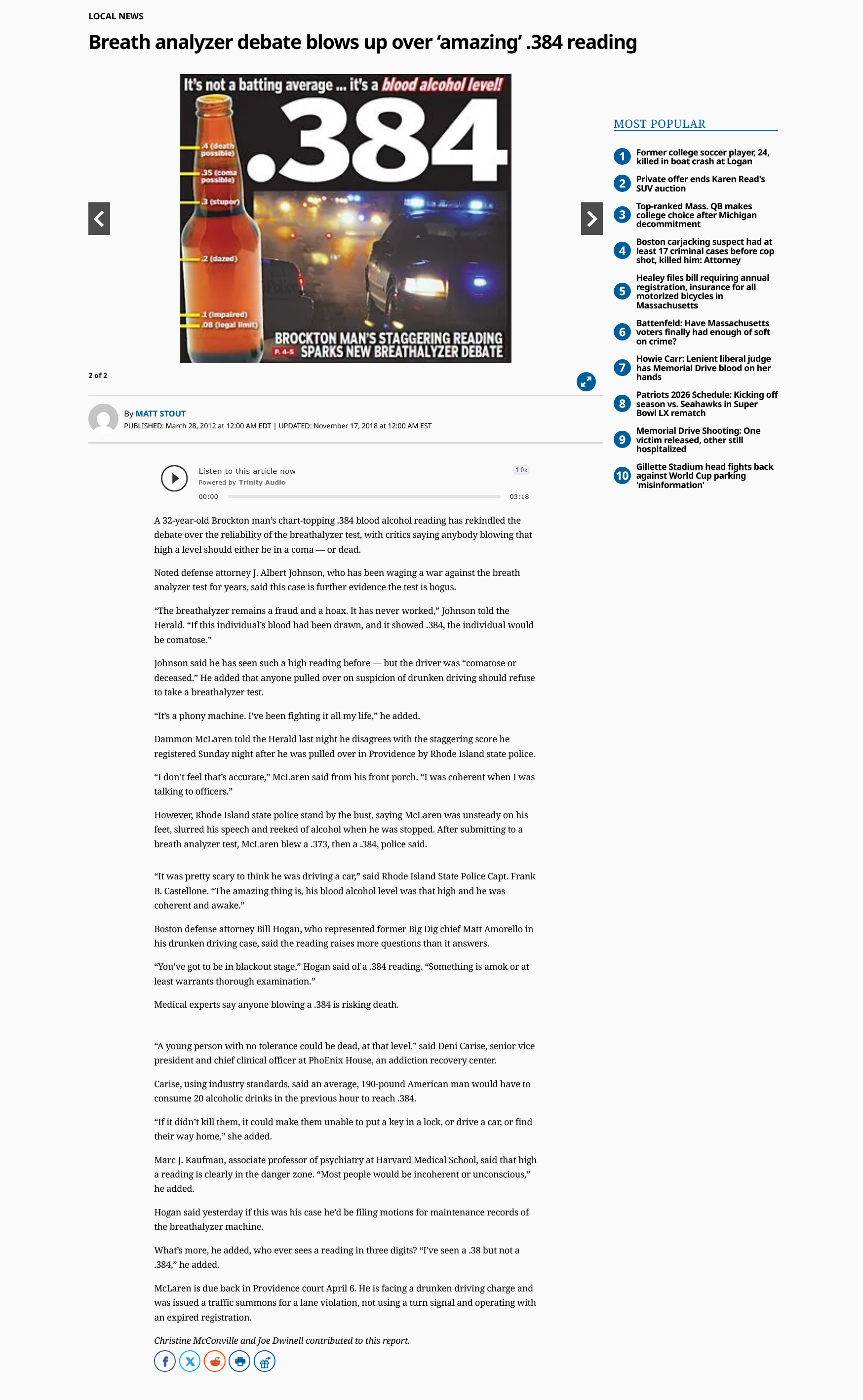
The vodka balloon riddle gives some explanation for the occasional news headline that marvels at a living, breathing test subject whose extreme breathalyzer reading indicated that he should be in a coma or dead. Boston Herald published one such article in 2012 under the title "Breath analyzer debate blows up over ‘amazing’ .384 reading" and contains some remarkable statements. I have created a full-page screenshot of the article for archival, educational, and journalistic purposes, which exempts it from copyright claims. You can read it by clicking the image below, which features the most interesting part (click the image for the 986.08 KB, 1,748x2,837 PNG version):
Two possible explanations for such an extreme reading are that either the breathalyzer was not calibrated properly or that the sample or the breathalyzer were contaminated in some way. A scientist trained in taking breath samples and handling devices that analyze them would know how to properly calibrate the breathalyzer and avoid contamination, but cops are not scientists, and their training even in basic functions of police work, such as writing reports, is often lacking. They get paid whatever the outcome on a breathalyzer, so why should they care either way?
Calibration issues with breathalyzers happen because they are supposed to be calibrated from time to time. I asked a licensed traffic expert here in Bosnia and Herzegovina about the process, and he said that here they need to be calibrated in an institute qualified to perform scientific measurements at least once a year. In the US, a cop can do it, as shown in the YouTube video titled "How Do Breathalyzers Work?" published March 10, 2014, by the channel "Reactions," where we see a cop using a gas mixture at the police station to calibrate a breathalyzer. The video also contains an explanation of how a breathalyzer works by the same cop, Corporal Michael Rose from Prince George's County, Maryland. I've recorded the audio of it, which you can listen to by clicking here (1.03 MB MP3 file). The most interesting part in the audio recording is when he says this (emphasis added):
With your breath, there is a direct correlation between the percentage of alcohol that's in your blood and the breath that's expelled. There's a 2,100:1 ratio. We can measure the amount of the air, and the air is going to have the same proportion of alcohol in the air that's coming back out as was in the blood that's flowing through your body.
That is an interesting statement because it finally reveals the mysterious number that underpins breathalyzer operation. However, the number is very specific, we are not told how it is determined, and it is remarkably high. I do not know of any other measurement process where the measurement is multiplied by 2,100 to get the actual result. To put it into perspective, that 2,100 multiplier is the difference between your body weight and the weight of seventy Ford F-150 King Ranch SuperCrew 5.5' Box Trucks stacked on top of each other, which indicates that the breathalyzer he showcased is way too small for testing humans, and the logical conclusion is that it was originally made for testing some other mammal with a much smaller frame, like a rodent. I would say a typical person weighs 80–100 kilograms, or 80,000–100,000 grams. Divided by 2,100, this gives 38–47 grams, which I would say is the weight of an adult lab mouse, and a cursory internet search shows that adult laboratory mice can weigh between 20 to 40 grams, depending on the strain, which roughly lines up with the concept.
It is therefore logical that the breathalyzer shown in the above YouTube video by Corporal Michael Rose, the Alco-Sensor III sold by Intoximeters, was originally designed and sold for some other purpose, such as laboratory testing of mice, and that it repeatedly failed to meet the scientific standards of reliability and accuracy, which is why labs stopped buying and using it. Intoximeters pivoted and sold it off to police stations to be used on humans with the caveat that the result needs to be multiplied with that magical 2,100 number to reach an approximation of the test subject's blood alcohol levels. In fact, if you look at the product page for that breathalyzer on the Intoximeters webpage, you will see an interesting remark (red font color present in the original):
NOTE: The Alco-Sensor III is only available as a refurbished instrument. Please request product information for details.
That appears to be a legal disclaimer, which should not be necessary unless there are some legal issues with the validity of the test results. What could those issues be, and why is the disclaimer not written there for everyone to see? Perhaps the answer is that the issue concerns test subjects, and if they knew about it, they would go berserk, and the only reason for such a reaction is because the breathalyzer in question is unfair to them and produces false positives in abundance. Intoximeters would then try to hint at the legal issues without outright mentioning them, hence the remark in red.
Perhaps the disclaimer is to warn the cops trying to buy Alco-Sensor III that their readings were repeatedly thrown out of court because they are not reliable enough to be taken as proof of anything and that they can only be used to extract confessions? It would make sense that the remark was then included to prevent police departments who might want to purchase and use that breathalyzer from complaining to Intoximeters about the invalid results getting thrown out of court. I also clicked around on the Intoximeters website and landed on the page titled "Physiology," where I found the following text (emphasis added):
Intoximeters, experts in Breath Alcohol Testing since 1945, provides the following white paper as a public courtesy. We specialize in evidential breath alcohol testing instruments and training, and are trusted by law enforcement and government regulatory agencies world-wide as a leader in the industry.
Can you see what is missing there? Law enforcement is the executive branch; government regulatory agencies are the legislative branch; where is the judicial branch? If Intoximeters' breathalyzers were trusted by the judicial branch, I am sure that would be mentioned in the text, and since it is not, it means that judges do not trust Intoximeters' breathalyzer results. Why? Perhaps because their devices are unreliable and meant for testing lab animals of a smaller frame, which gives false positives in humans, causing them to be thrown out of court? Once you open your mind and think without any extreme emotions clouding your judgment, you can see everything like it is in the palm of your hand, no matter how well it was hidden. I believe it is this state of clarity that people are looking for when consuming various drugs and engaging in vices.
The more you think about breathalyzers, the sooner you will come to the inevitable question, "Why aren't we using the science behind them to diagnose illnesses?" If breathalyzers could indeed tell us something about the human body on the basis of breath alone, we would already be using them to diagnose ourselves, our next of kin, and our pets for signs of infections, allergies, cancers, dementia, stroke, heart attack, autoimmune disease, internal injuries, and much more. Imagine the world in which everyone has a reusable, reliable handheld device that can do a non-invasive, medically valid test on the human body for a fraction of a penny wherever and whenever — no scheduling, no health insurance needed, no money paid out of pocket, no visit to the hospital, no doctor's appointment where you feel like an idiot as you describe your symptoms to a doctor who acts like you are making stuff up, no paperwork, no knot in the gut as you wait for the result, and no chance of injury due to medical error; just blow into a breathalyzer and get your test result back instantly.
Where is this device? Why are we not funding it to have it publicly available? Why is it a mysterious device used only by cops? Why are we wasting this supposedly amazing technology on catching drunk people? Is it perhaps because breathalyzers are neither reusable nor reliable and that they are so narrow in application that they can only detect those substances prone to evaporation, especially alcohols, the number of which is beyond count in the human body, and that they are useless for detecting anything else? It is perhaps because breath analysis is medically meaningless and scientifically inconclusive? Is it perhaps because medical professionals have already tried applying breath analysis on their patients and discovered, much to their chagrin, that breath analysis is riddled with so many problems as to be pretty much useless, and that there is no conceivable way to create a reliable handheld breath analysis device?
The breathalyzer technology, if it really worked as we are led to believe it works, would be a civilization-changing, life-saving invention on the level of clean drinking water or electricity, and everyone would have access to a medical-grade breathalyzer at all times because it would be in every pocket, in every household, in every car, in every desk drawer and kitchen cupboard, in every office, in every grocery store, and in every school and kindergarten as a truly helpful device that can detect health problems before they happen. Yet, breathalyzers are kept under lock and key and only used by the select few who will not tell us how they work, and this is obviously because breathalyzers do not have a valid medical purpose and are a scam. It is unbelievable to me that nobody is talking about this.
Not only are breathalyzers not prolific, but they are not for sale to physical persons. If you try to buy a breathalyzer from the same supplier that sells them to cops, I guarantee that you will not be sold one. The reason is very simple — the supplier knows that they are a scam and that cops will not tattle on him because they are involved in the scam but the general public might if it gets to test them. You can either go through the effort of trying to order one to test it out, or you can skip all that and just read how doctors have tested breath analysis in medicine and why they have given up on it for the fear of false positives and false diagnoses.
The Wikipedia article "Hydrogen breath test" states (emphasis added):
A hydrogen breath test (HBT) or hydrogen-methane breath test is a breath test used as a diagnostic tool for small intestine bacterial overgrowth (SIBO), and carbohydrate malabsorption, such as lactose, fructose, and sorbitol malabsorption. The test is a simple, non-invasive procedure, and is performed after a short period of fasting (typically 8–12 hours).
Hydrogen breath tests are based on the fact that there is no source for hydrogen gas in humans other than bacterial metabolism of carbohydrates. The test is normally known as a hydrogen breath test, but often includes testing for methane. Many studies have shown that some people (approximately 35% or more) do not produce hydrogen but actually produce methane, and sometimes a combination of the two gases is found.
Other people, who are known as "non-responders", don't produce any gas; it has not yet been determined whether they may actually produce another gas. In addition to hydrogen and methane, some facilities also utilize carbon dioxide (CO2) in the patient's breath to determine if the breath samples that are being analyzed are contaminated (either with room air or bronchial dead space air).
Physicians have expressed concern at the improper use and widespread overdiagnoses related to interpretation of these tests.
We can note that having a meal can contaminate the test subject's breath for 8–12 hours. I am not sure how that works, but it is consistent with what we saw with Mr. Williams. Also, we can see our good friend, sorbitol, for which we have indications that it is a byproduct of diabetic metabolism, as another potential contaminant.
Another breathalyzer-like medical device called "Halimeter" is used to diagnose people with halitosis aka. bad breath. Let's see what the Wikipedia article "Bad breath" has to say about the device and its limitations (emphasis added):
Halimeter: a portable sulfide monitor used to test for levels of sulfur emissions (to be specific, hydrogen sulfide) in the mouth air. When used properly, this device can be very effective at determining levels of certain VSC-producing bacteria.
However, it has drawbacks in clinical applications. For example, other common sulfides (such as mercaptan) are not recorded as easily and can be misrepresented in test results. Certain foods, such as garlic and onions, produce sulfur in the breath for as long as 48 hours and can result in false readings.
The Halimeter is also very sensitive to alcohol, so one should avoid drinking alcohol or using alcohol-containing mouthwashes for at least 12 hours prior to being tested. This analog machine loses sensitivity over time and requires periodic recalibration to remain accurate.
Now we see another cause of false positives: alcohol-containing mouthwashes. Drinking "alcohol" or rinsing the mouth with "alcohol" appears to have the same effect of contaminating the breath with alcoholic vapors, and the effect seems to last at least 12 hours, which again lines up with what we saw with Mr. Williams. In all likelihood, him just chewing the Traditional Hot Cross Bun and spitting it out would have produced a positive result on the breathalyzer, but we cannot tell whether it would be 0.21.
The Wikipedia article "Urea breath test" states that (emphasis added):
The urea breath test is a rapid diagnostic procedure used to identify infections by Helicobacter pylori, a spiral bacterium implicated in gastritis, gastric ulcer, and peptic ulcer disease.(...)
Patients swallow urea labelled with an uncommon isotope, either radioactive carbon-14 (nowadays preferred in many countries) or non-radioactive carbon-13. In the subsequent 10–30 minutes, the detection of isotope-labelled carbon dioxide in exhaled breath indicates that the urea was split; this indicates that urease (the enzyme that H. pylori uses to metabolize urea to produce ammonia) is present in the stomach, and hence that H. pylori bacteria are present.(...)
(...)Some clinicians believe that a reservoir of H. pylori in dental plaque can affect the result.(...)
An interesting article titled "New Breathalyzer Can Test Blood Glucose Levels" and published on Diabetes365.com on May 8, 2026, hinted at the possibility of a novel medical-grade breathalyzer that could help diabetics manage glucose levels (emphasis added):
The new device that is still in development would work similarly to an average breathalyzer. But how does a breathalyzer detect abnormal glucose levels in a person’s breath? The breathalyzer device contains polymers which react with acetone, which is one of the ketones produced in diabetics. The higher glucose levels in the body, the higher amount of acetones found in the breath. (...) While the goal of the new device is to completely replace finger pricking, it’s still unknown exactly how accurate these breathalyzers are going to be. It’s been proven that a higher amount of acetone in the breath is a side effect of high blood glucose, but it still isn’t known if the higher acetone has a direct correlation between glucose levels.
The Wikipedia page "Acetone" states the following (emphasis added):
It is the simplest and smallest ketone (...) It serves as a solvent in household products such as nail polish remover and paint thinner. (...)
Acetone is produced and disposed of in the human body through normal metabolic processes. Small quantities of it are present naturally in blood and urine. People with diabetic ketoacidosis produce it in larger amounts. Medical ketogenic diets that increase ketone bodies (acetone, β-hydroxybutyric acid and acetoacetic acid) in the blood are used to suppress epileptic attacks in children with treatment-resistant epilepsy.
Certain health conditions, such as alcoholism and diabetes, can produce ketoacidosis, uncontrollable ketosis that leads to a sharp, and potentially fatal, increase in the acidity of the blood. Since it is a byproduct of fermentation, acetone is a byproduct of the distillery industry. Acetone is naturally occurring. It is produced by terrestrial vegetation, undefined ocean processes, incomplete combustion of biomass, or oxidation of hydrocarbons in the atmosphere.
If you then go into the Wikipedia article "Breathalyzer," you will find the following (emphasis added):
Some natural and volatile interfering compounds do exist, however. For example, the National Highway Traffic Safety Administration has found that dieters and diabetics may have acetone levels hundreds or even thousands of times higher than those in others. Acetone is one of the many substances that can be falsely identified as ethyl alcohol by some breath machines. However, fuel cell based systems are non-responsive to substances like acetone.
Therefore, if you ate something, it can trigger a false positive in a breathalyzer, but if you ate nothing or are a diabetic or are on a medical diet or are dieting, your body produces acetone, which is a substance that might also trigger a false positive in a breathalyzer. It is a brilliant scam, is it not? Breathalyzers can produce a false positive for pretty much everyone, and I am sure the cops know how to do it, just like we saw with Mr Williams. Whoever thought of a breathalyzer as a device for testing "alcohol" levels really knew what he was doing.