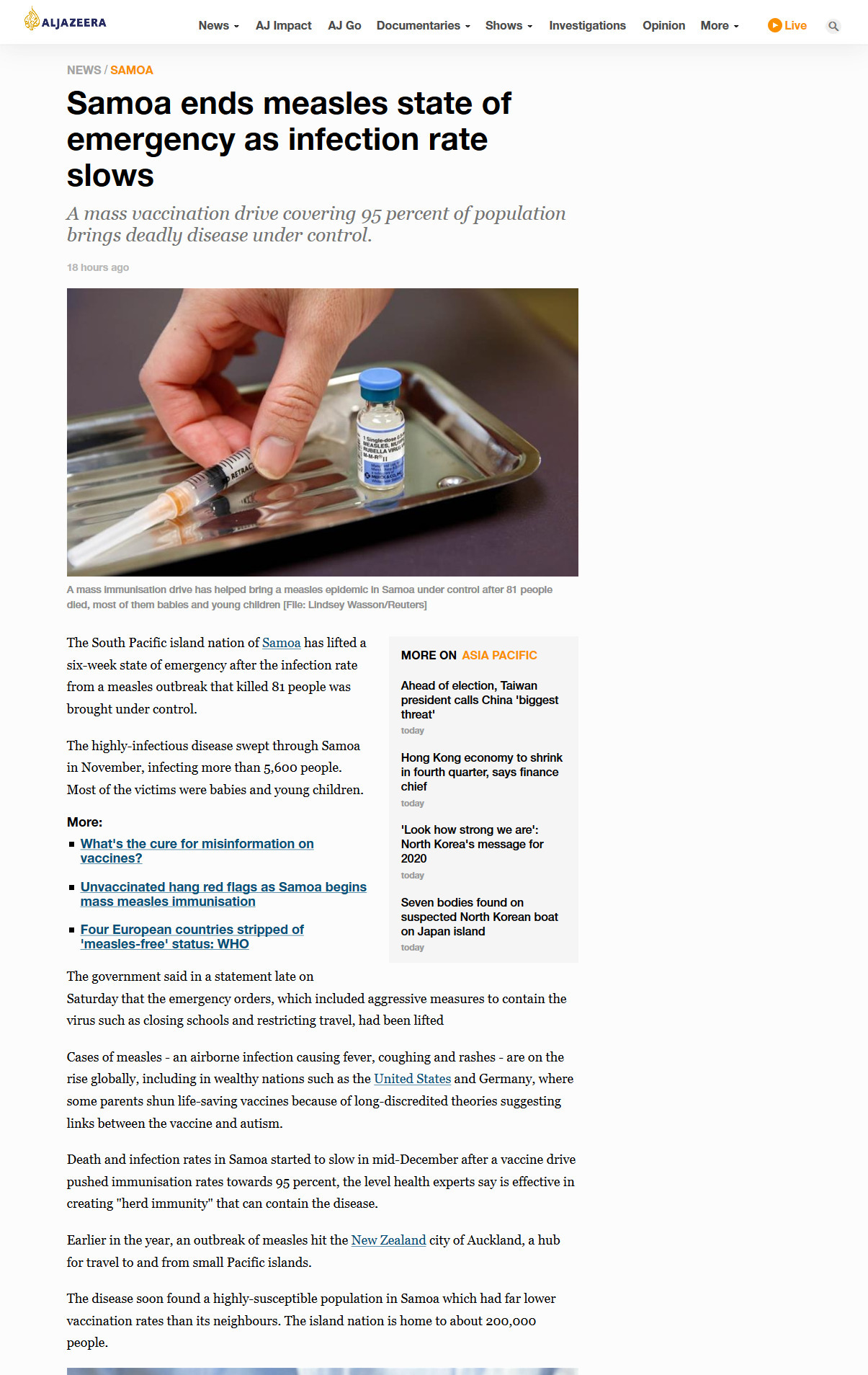
How would you define the word "deadly"? TheFreeDictionary.com suggests "causing or tending to cause death" and I would agree with that. Apparently, that's not the same definition Al Jazeera journalists used when writing one of their article ledes regarding the measles epidemic on Samoa.
The below picture shows a snippet of Al Jazeera's news article published December 29, 2019. There is another interesting paragraph in the article right below the image but this right here is the money shot (click the image for a 588.63 KB, 1205x1908px full screenshot of the entire article made for archival purposes).
Based off the title and lede, you'd think the measles epidemic would have infected at least 80% of the Samoa's 200,000, right? Guess again, because it's actually (drumroll) 5,600 or 2.8% and the disease killed 81 out of those or 1.4% of the infected.
The 1.4% mortality rate in the Samoa measles epidemic is actually quite a bit higher than what Wikipedia states, which is "1-2 per 1,000 people" or 0.15%. So, the mortality rate is 10 times higher than expected, presumably because of bad hygiene and attempts to heal the infected, which are typically children and babies, with voodoo medicine.
Still, it's nowhere near "deadly" but it is an epidemic thanks to the vague World Health Organization definition that says it's a disease "clearly in excess of normal expectancy". Keep this definition in mind when being screeched at the next time by the mainstream media that there is an epidemic.
Ultimately, the article brings very little content and the majority of it is in the top half, which is consistent with clickbait just wanting to get you to click by seeing a fancy image and a scary headline. By the way, that image is unrelated to the topic, which is a trick I used to do as well because I didn't know any better. Why? Well, that's what the client wanted and the explanation was the same one I am telling you – text is scary and pictars are pretty. I would explain it as "pictures stimulate and the text engages", meaning online content producers want to stimulate us to come in but not engage us to the point we stay.
The Al Jazeera article lists "Lindsey Wasson/Reuters" as the photo credit; searching for that led me to a Reuters article on measles published August 9, 2019 with the exact same leading photo (click the image for a 108.8 KB, 695x775px version with added text for context).
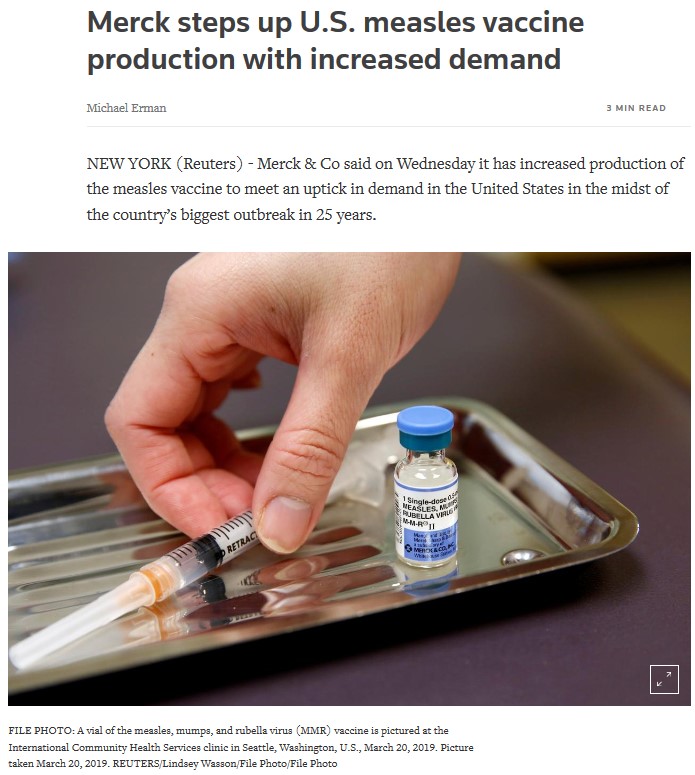
That second article talks about Merck ramping up measles vaccine production due to increased demand and the photo credit said it was taken at "the International Community Health Services clinic in Seattle", March 20, 2019. Besides that article being obvious shilling for Merck, let's see where else the same image was used.
I had to squish these following images a bit but I think they work well enough to illustrate the point. In the following image collage, you can see screenshots of four distinct articles using the exact same image with different headlines (click the image for a 482.46 KB, 1714x1230px collage of four article headlines and images).
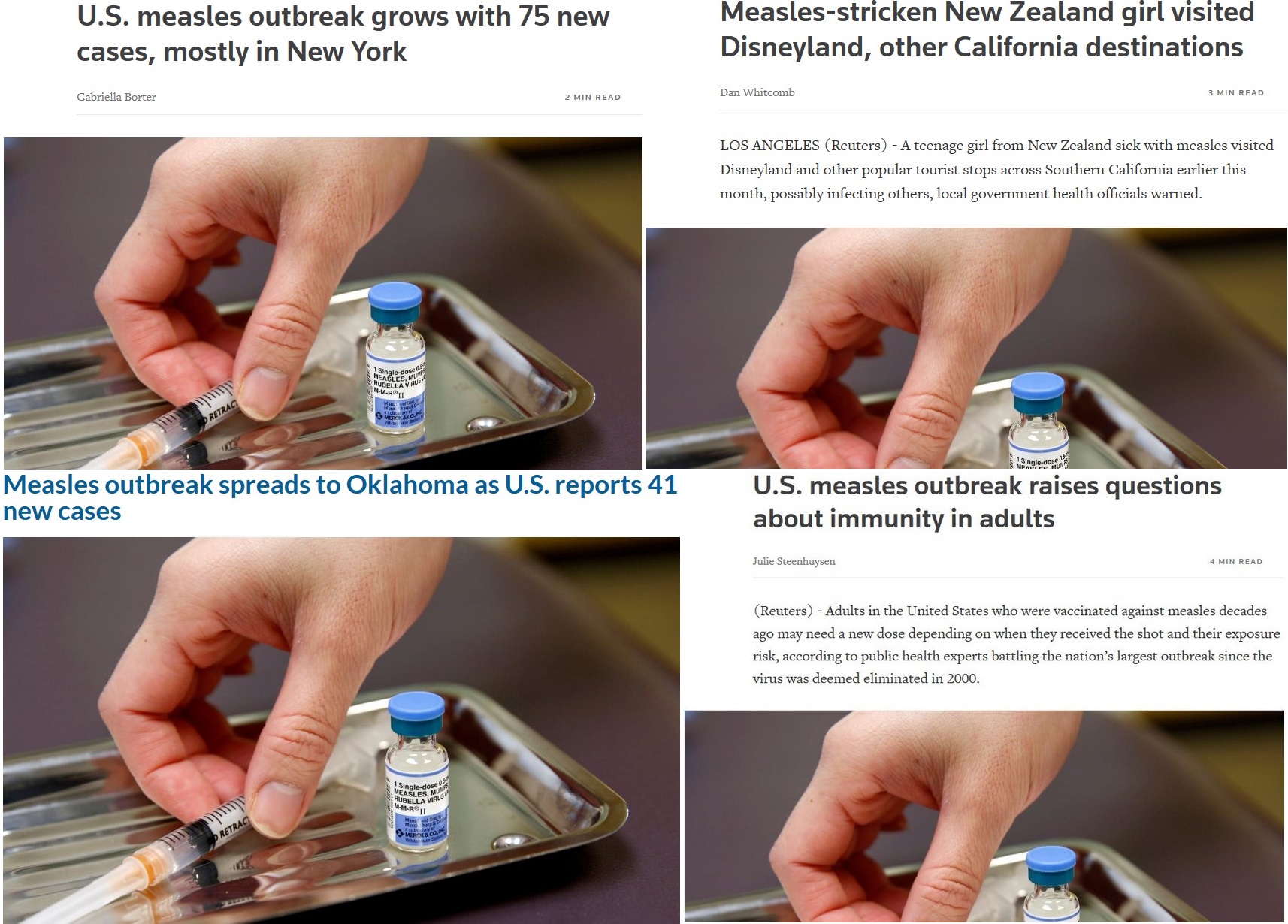
I made that using Paint so the quality isn't that great but the headlines should be visible enough so you can search for the articles yourself and see it's all real. Now that's transparency, something that's readily made to be checked.
Let's go deeper, shall we? This collage contains screencaps of 12 news articles, all using the exact same image you already saw above. Again, sorry for the noob cropping action but there was no consistency between these websites on how they used the image so I had to crop a rectangle of the same size or I'd be stuck making the collage for days (click the image for a 939.86 KB, 2416x1828px collage of 12 article headlines and images).
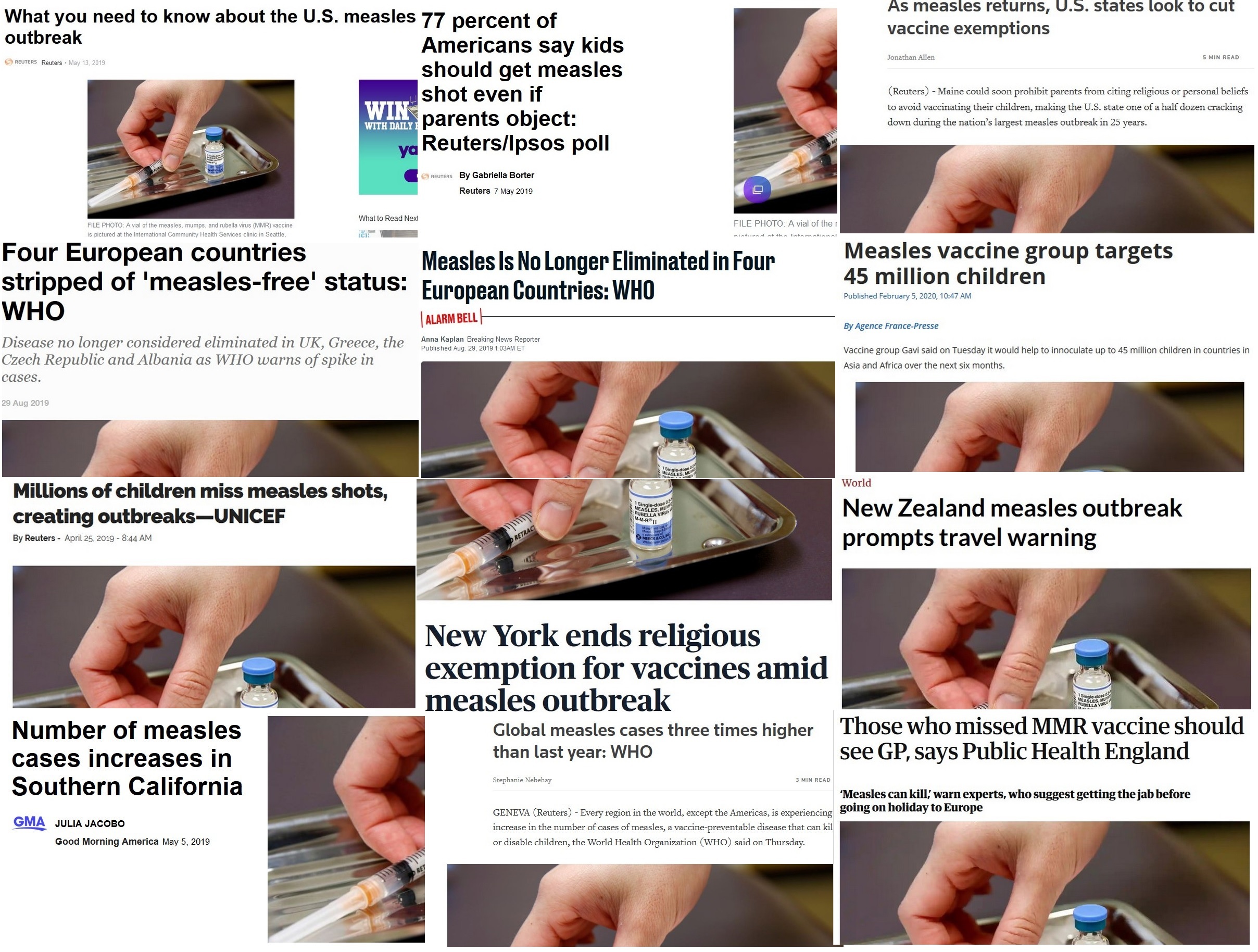
I understand why Reuters writers and editors would rehash the same images—the human brain constantly looks for a shortcut to save energy and time. I'm not bashing Reuters for rehashing the same content but there needs to be some honesty and transparency when doing so. I also think the lack of self-critical introspection is really baffling for them when they should be representing journalistic standards.
Reuters actually boasts what it calls "Trust Principles", which in part state:
That the integrity, independence, and freedom from bias of Thomson Reuters shall at all times be fully preserved;
That no effort shall be spared to expand, develop, and adapt the news and other services and products of Thomson Reuters so as to maintain its leading position in the international news and information business
The "spare no effort" part seems to me as a promise to not become that lazy as to repeat the exact same image across articles. Keep in mind, the image I'm referring to was made mid-2019, which means it's likely to keep popping up over time.
By now you've realized that making clickbait involves a lot of copy/paste action but there's also a weird juxtaposition of certainty with uncertainty. On one hand, clickbait writers know for certain that something is a danger but on the other are completely uncertain about any details related to the danger. This means clickbait involves hedge words such as "could" and "may", uncertain phrases attributed to vague sources and just overall laziness in writing combined with bombastic words such as "killer", "death" and so on.
For example, a clickbait headline might go: "KILLER HORNETS may come to the US soon". The notion of killer hornets is implanted in the reader's subconscious without specifying any added details about them. This idea creates fear that paralyzes the reader and causes a frantic reading of all the related articles. How far can they fly? What country are they native to? The clickbait article typically eschews these questions and doesn't dwell on the logistics.
To drive fear into the reader's subconscious, the clickbait article must use a visual source of information that is somewhat but not fully related to the topic. Not all the images from my clickbait collages were from Reuters, but that only goes to show everyone is using clickbait images. It's the simplest way to attach emotion to content and guarantee traffic.
From my experience, images are used in news articles in this way because of two reasons:
If I were Reuters and adhered to Trust Principles, I would include a disclaimer that the image is unrelated to the article and is used for illustrative purposes only, which I've seen other news sources do to no detriment to the article.
Always pay attention to adjectives in news headlines, since they are almost always used to mask the piddling numbers in the article body that contradict the sentiment presented in the headline. In this case, we have a "deadly" disease in the lede but the article body reveals it's only 1.4% of the infected sliver of the population or 0.04% of the entire population. Once you:
the article headline becomes "0.04% of Samoan population died in a measles outbreak", which might not be as clickable but at least it would be factual.
Stirring emotions using clickbait is such a dangerous thing because it essentially inflicts emotional trauma on the person. I found myself writing clickbait headlines too, despite doing my utmost to not do so and actually starting this website to make a safe haven from clickbait for everyone. When talking about clickbait to a cousin, I literally described it as "emotional and verbal pollution", and I think that's the most succinct description I can give. Don't let your emotions be stirred, always check the numbers and try to see if the image is of the actual event or just an archive photo that's there to serve as a visual anchor.