Ah, they don't make them like they used to. In the 21st century, the movie industry churns out endless sequels and reboots, but in the 20th century, movies were a different ordeal. Actors had to act and stuntmen had to, well, stunt. This is a marvelous 2h13m movie, one worth watching and drinking in slowly, like a fine wine.
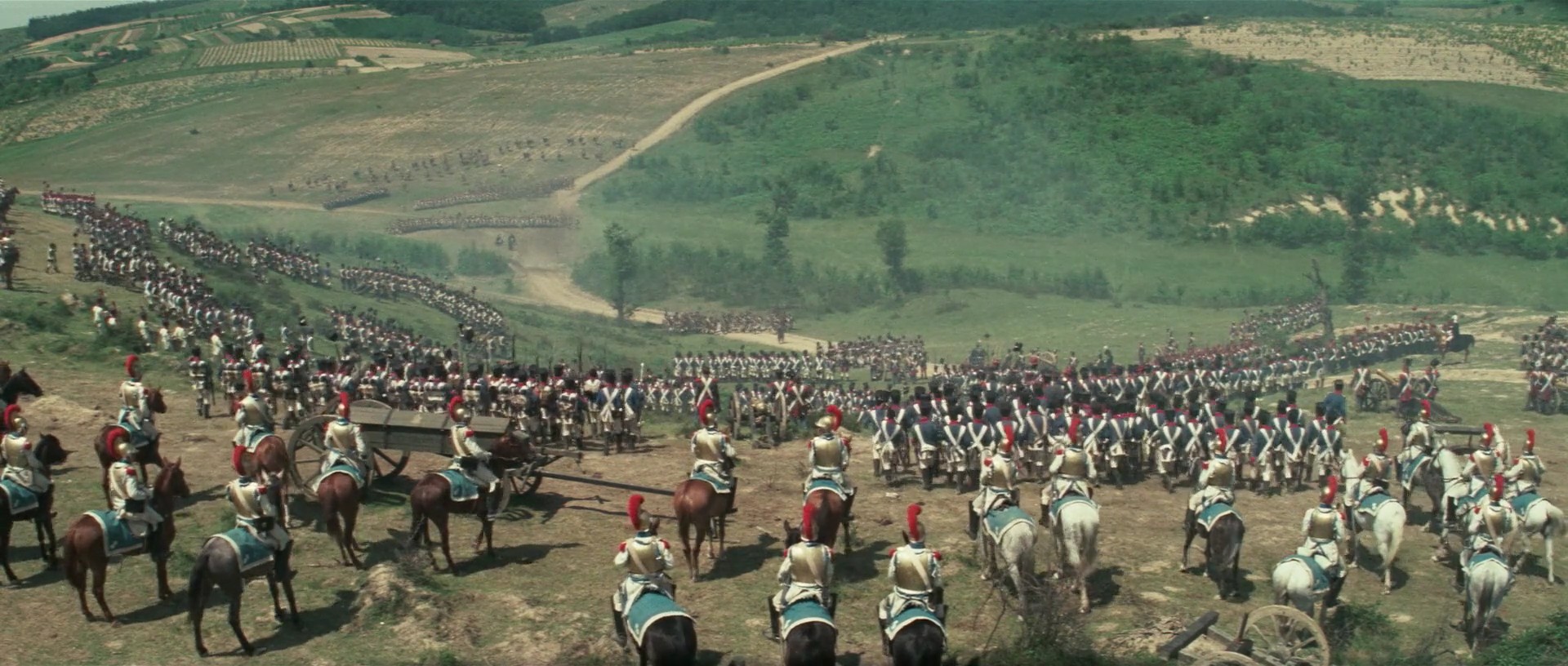
Early 19th century. Napoleon Bonaparte has failed in his lofty goals and is forced to abdicate by joint European forces. He is gracefully given reprieve on the tiny island of Elba, with up to 1,000 men. He bitterly accepts, only to make a desperate dash for the French soil a few months later. The French king Louis XVIII orders his general to stop Napoleon with an entire army but it defects, along with the general (click the image for a 1920x816px, 381.86 KB version).
The king's forces are on the hill; Napoleon is the person in black garb in the middle of the road. The combined forces of Europeans will face him at Waterloo, where Napoleon will meet his ultimate defeat at the hands of Duke Wellington. Sorry, spoilers.
The first third of the movie provides the above background to the movie. It's at a ball that Duke Wellington receives word that Napoleon has entered Belgium. The Duke will face him at Waterloo.
Napoleon meets the Prussians and kills 16,000 men, though they retreat in good order. It still won't be enough. Napoleon orders 30,000 of his men after them to not let them regroup. His generals doubt his orders so he shouts them down, which is not a good sign. Despite drawing first blood, Napoleon is still outnumbered and his generals don't believe they can win (click the image for a 1920x816px, 216.78 KB version).
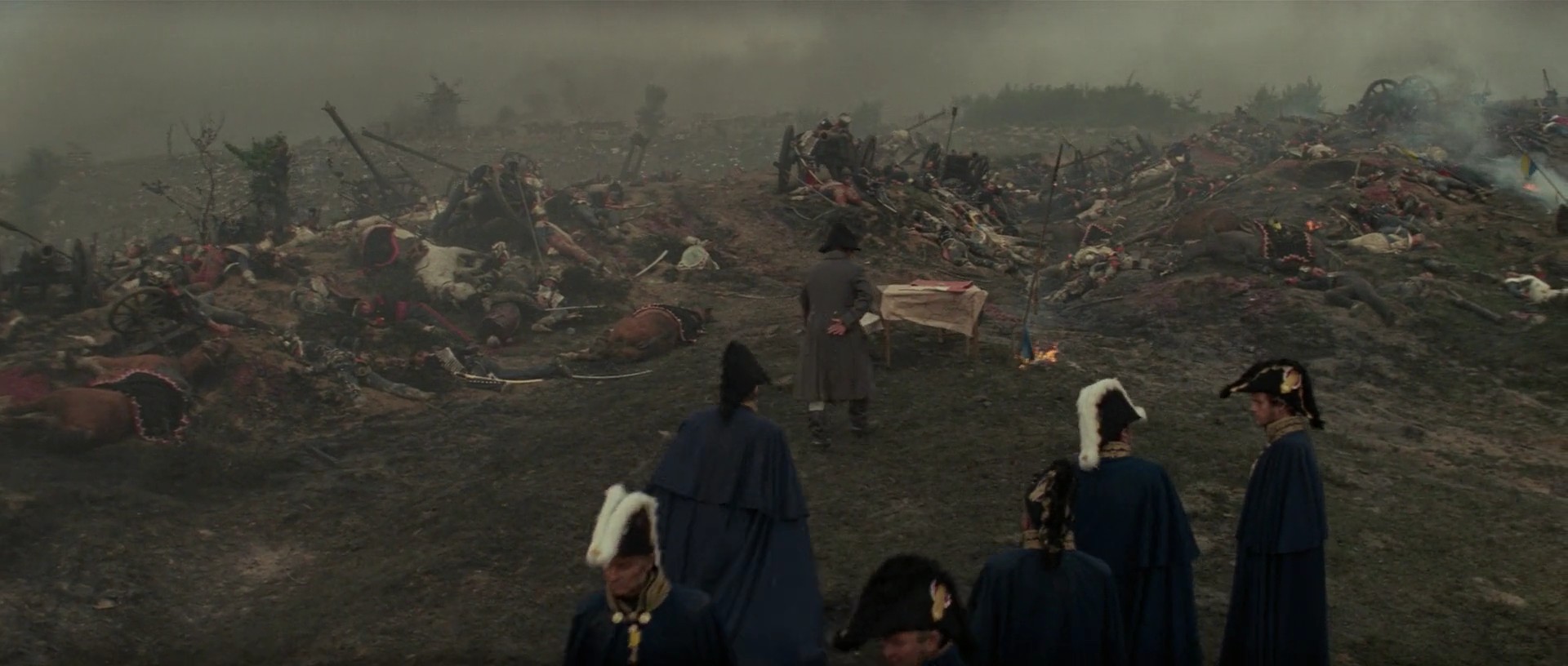
Heavy rain makes the battlefield a mire. Napoleon observes the positioning of Duke Wellington and comments he is no student of Caesar; he's got the trees to his back. English soldiers are in good spirits but Duke Wellington thinks he's already lost.
Meanwhile, Napoleon is doubting himself and overthinking. He can't understand how his part of the army can't catch up to Prussians. He feels terrible stomach pain, which Wikipedia explains as him having stomach cancer. One theory there alludes to him being poisoned. He doesn't want a doctor. Barely standing and can muster nary a whisper. He gathers all his mental and emotional strength for tomorrow.
Napoleon has a meal with his generals. He tells them they'll need bigger napkins and they laugh. The ground will not dry before noon. Napoleon seems worried. A church bell rings. Napoleon slams his fist on the table and leaves. Generals stand up and leave too, following him to his room. They need four more hours or the cannons will get stuck in the mud.
Napoleon wants to move right away, since battles are won or lost in the quarter of an hour. He doesn't take lightly to this. Meanwhile, Duke Wellington is nonchalant and doesn't even consider the idea of defeat. Did he bribe or otherwise persuade the French generals to betray Napoleon? Seems suspicious.
Frenchmen make a formation with music and singing. Duke Wellington sees "the monster". One of his officers wants to try a shot at Napoleon but Duke Wellington won't hear about it; commanders have better things to do than fire at each other. Napoleon realizes the mud is everywhere and he gets stuck getting off his horse. A voice in his head whispers dreadful ideas of defeat.
He takes a spyglass and looks at the enemy, whose guns are on his right flank. Therefore, that's where the enemy will be teased. When he weakens his center to support his right side, he will know the strength of Duke Wellington. At 11:35, the French cannons start firing. Englishmen fire back. The French advance.
The pitched battle carries on, with Duke Wellington not moving his center. Napoleon is impressed and orders heavy artillery aimed at the Picton (I am unsure where Picton is). The Scots take a sip of gin before the melee starts. Some are seen with prayer beads. The thunderous march of the French is heard just yonder. They prepare to advance. The French have drummer boys, literally kids, marching alongside them.
The English officers take some snuff (snorting tobacco, I presume). We hear an old Jew in Alexandria prepared the blend. They roll out the bagpipes. Good God, the sound rends my soul. The armies meet and the cavalry charges. One piece of trivia says the stuntmen were so terrified of the cavalry charge, even when feigned, that they would scatter so the scene was cut in half.
Napoleon says they will match their cavalry with lancers. Total chaos as horses fall and riders get thrown off. Good Lord, this is the closest I've seen to an actual cavalry charge in a movie ever. The anecdote says that the extras were so terrified of the cavalry charge that they didn't want to stand anywhere near its path. Watch a short clip of the charge here. It is an 11-second 1920x816 resolution MP4 video, 14 MB in size.
One third of Napoleon's army is marching slowly. They won't run to the sound of the guns. The general leading it is eating strawberries and won't hurry anywhere. His orders were precise. The English side of the battlefield is also trying to guess whose army it is. Napoleon says they should fight as if though the Prussians are on the Moon.
The smoke curtain hangs thick in the air. Napoleon pants and looks around, trying to find the missing third of his army. He falls down holding his stomach. His field doctor advises him to lie down for an hour. He's toast, French toast. He rests his weary head in a barn.
Napoleon tells to himself he promised himself 6 more good years after Austerlitz. His officer is listening to his every word. Duke Wellington orders his army to retreat a 100 paces. The French army moves forward, hoping to strike the English in the back.
The French ride right into the ambush and die en masse. The English have made defensive squares and start firing at the horses (click the image for a 1920x816px, 211.67 KB version).
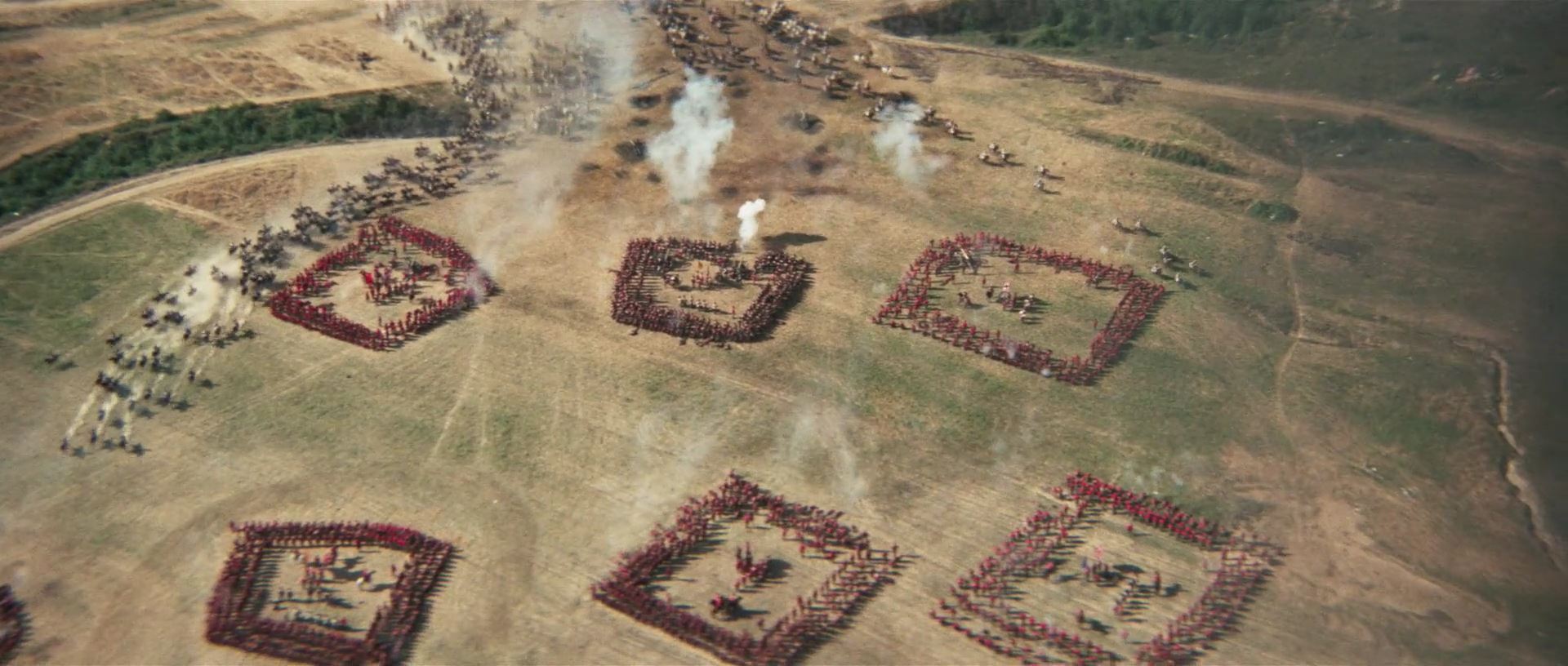
Napoleon runs in and yells at his generals. Meanwhile, the squares squish the cavalry between their ranks. Total chaos. One French rider kills one of the bagpipe players. THANK YOU. Some quite apocalyptic imagery there as buildings burn and people slaughter each other.
Napoleon dictates a letter to Paris, saying he won the war. Duke Wellington says it appears they're losing the battle. He's totally shaken. Napoleon moves his old guard forward and insists on riding in front of the army. His generals shoo him away to the back.
Duke Wellington orders his troops rallied. They are down to 5 rounds of ammo each. Only a miracle can save him now. Prussians are in the woods. Napoleon says he should have burned Berlin. Prussian general, Bluca, says no prisoners. The English get up from the grass, having made another ambush. The French fall down like wet sacks.
He says he's been through this kind of scenario before and won. The old guard has broken and is routing. Duke Wellington is gloating. The French can't form squares in time. They are invited to surrender but refuse. Cannons were wheeled in and fire at point blank range.
The night sets. Duke Wellington canters around the battlefied and sees the killed bagpipeman. The sounds of the battle echo through his head. He is in a gloomy mood still. Good God, so many corpses. The rain falls as Napoleon staggers around, defeated, destroyed. He enters a carriage that goes but where? The smoke still billows.
To me, it's quite clear Napoleon was backstabbed by his generals and gut-stabbed by his doctor. Again referring back to the Wikipedia article on the man, we see his body was exhumed 20 years after death and found almost perfectly preserved. This points to abundant arsenic poisoning, which is known to mummify the body. That we can now link back to the stomach pain he had in the crucial moment.
Apparently, Napoleon liked drinking some fruit liquor, which is how I'm guessing he was given the dose of poison to incapacitate him throughout his campaign but also when he started winning. It sounds natural that a man of his caliber would drink up in the heat of the battle, especially when he felt he had already won. A 21st century analysis of hair samples gathered throughout Napoleon's life showed he was apparently exposed to arsenic levels 100 times the accepted average today all throughout his life, though I'm not buying it.
His generals intentionally sabotaged his every effort, except perhaps the one that advised waiting until the mud dried out before the battle. They listened to his orders literally and suicided his army as soon as he retreated for an hour of respite. The English were also able to make two major ambushes, which seemed doomed to failure, unless the French generals knew about them and steered their army on purpose to its doom. To me it seemed at the start of the movie the generals weren't eager to fight any more wars and perhaps even felt a tinge of jealousy with Napoleon.