Stefan Molyneux is a Canadian author and entrepreneur turned video content creator, philosopher, and psychotherapist. I won't be waxing his pole with numbers that show his success, mainly because I don't have them handy, but also because they shouldn't be relevant to his ideas past, present, and future. A man should be evaluated on the merits of his best and worst moments in life; amplitude rather than frequency, so to speak.
Just throwing oneself out there and constantly talking or writing all but guarantees success, as shown by people like Gary Vaynerchuk, who says such simple ideas but gets massive attention and speaker fees in the vein of $200k per speech (!) because he's fervent in publicizing them. Besides, market conditions value compulsive content producers, meaning it's expected that people successful to any degree have a fat, long, throbbing portfolio primed to shoot out a thick glob of information in our faces at a moment's notice.
I was intrigued by Stefan's constant mentioning of his book as the reference point for his arguments, but I was also confused that he never explained what's written in the book; Stefan would basically say to everyone he debated, "If you haven't read my book, we have nothing to talk about" as a way to easily settle a debate on any particular point.
The foundation of Stefan's philosophical attitude is his book "Universally Preferable Behavior — A Rational Proof of Secular Ethics," and based on his behavior, that book is where he details his philosophical paradigm aka. world view. My goal is to analyze the book first and the ideas in it second, and to distinguish between the book and the paradigm, I'll call the former UPBARPSE and the latter just UPB. I believe this is important because UPB is delivered through UPBARPSE, a vehicle with its own limitations and potential flaws that shouldn't make us see UPB in a bad light. Also, UPBARPSE just sounds so much sexier than the full title (hint for book writers: think of a subtitle that makes a cool acronym for easy marketing). I do dabble in writing myself, so I thought it interesting to analyze not just the ideas but also the writing style of a fellow author, to tease apart the word strands and see what wondrous thoughts lie beneath.
Counting 134 pages (PDF format), the book is marked as version 1.0 and dated October 2007. Whatever his ideas in UPBARPSE are, Stefan apparently found them so convincing and definite that he never revisited them. I find this noteworthy because there's rarely any such idea or belief that doesn't get updated or upgraded over time; I know because I had held such ideas until reality made me bow my head in shame as to how idealistic I was. This does not bode well. When I write a text that means something to me, I tend to obsess over it. The fact that Stefan never did it with his book shows that he doesn't really care about it.
Foreword opens with a reference to fairy tales and monsters living in them, with Stefan fancying himself a humble hero that arrives and assaults the monster the likes of Socrates and Plato couldn't defeat, which is:
"the belief (...) the illusion (...) the fantasy (...) the superstition that, without the tirades of parents, the bullying of gods or the guns of governments, we cannot be both rational and good." (p. 7)
This is only the beginning of UPBARPSE but Stefan already frames the discussion in such a way that makes me queasy, namely by positioning anyone who would argue against UPB as living in illusion. It is just an implication but not a good one, as it taints the entirety of UPBARPSE. It's a chess match where Stefan brings a loaded shotgun to the table. For the sake of making a point, I'll call myself a critic of UPB, meaning a fervent believer in illusionary, superstitious fantasies. See what I mean? It's simply impossible to argue against UPB without strawmanning myself. Sabotaging your critic does not appear to me model behavior worthy of inclusion in UPBARPSE, an allegedly high-brow philosophical work.
Next up, Stefan assesses the mood of an entire generation by stating that:
"Internet has raised the suspicions of a new generation (...) has given birth to a new generation of nihilists, just as it did in 19th century Germany." (p. 8)
I find this generalization upsetting and not at all fitting for the topic of UPB. Is Stefan implying internet is turning us into neo-NSDAP members? I can't find any other plausible explanation for all the dramatic overtones and focus on 19th century Germany. Again, to me this seems like additional framing of the debate so that critics of UPB have to label themselves as nihilists and/or neo-NSDAP members. This does not bode well for UPB. No matter how strong the arguments afterwards, Stefan does not want to lose and has now also brought a chainsaw to the chess table, implying UPB isn't all that strong of an idea to stand on its own merits.
To end the foreword, Stefan says:
"I am fully aware that, at this moment, you will very likely be feeling a rising wave of scepticism. I fully understand that the odds that some guy out there on the Internet — the homeworld of crazies — has somehow solved the philosophical problem of the ages are not particularly high — in fact, they would be so close to zero as to be virtually indistinguishable from it. Still, not quite zero." (p. 9)
You will probably have to re-read this quote a few times until you get what Stefan meant to say. Got it? Almost zero but not quite? "I am THE ONE who solved it!" There was this massive problem of defining UPB, "a beast" as described by Stefan, and now he's THE ONE who solved it but also presented it in such a humblebrag way. Also, notice yet another framing of people on the internet as "crazies," which is Stefan bringing a taser to the chess table. He really doesn't want to lose and has the match rigged in every possible way.
After reading the first ~9 pages, I had to take a break because I felt miserable, as if I was waterboarded with a deluge of nonsense. See how well it turned out that I separated UPBARPSE and UPB? Because I'm not arguing against UPB, I avoid framing myself as all those categories Stefan so carefully laid out for his critics to fall into. I dodged Stefan's bullets; perhaps I am THE ONE? How is it possible that nobody told Stefan that he's framing his critics in a negative light before even saying a single word on UPB? Were all his book reviewers his family members and friends that avoided eye contact, said it was great and slowly backed away? I find UPBARPSE a fascinating read, mostly because it's quite telling that Stefan has nobody to give him real, measured, and honest criticism that would keep him grounded.
No matter how well UPB turns out to be detailed, the flaws in Stefan's writing, the incessant melodramatic descriptions of people who don't hold the same opinion, the framing of the debate and the gloating — it's incredibly exhausting and UPBARPSE's foreword is simply a bad piece of writing. I'm still holding out for the rest of the book to vindicate Stefan's claim of being an author, but from what I've read so far, Stefan is neither a philosopher nor a particularly good writer. Why mention Socrates and Plato and then just carry on without detailing their ideas?
In this section, Stefan says:
"I have set myself some basic ground rules" (p. 9)
I found the wording of this sentence very odd and in contradiction with what comes next. At first glance, it implies that Stefan limits himself, but once we go through the rules themselves and the way they're worded, we'll see that's not the case at all. Here are the rules (p. 9):
Can you see the contradiction? Stefan implied he set the rules for himself, but what he meant is that he actually set them himself! It's a debate where Stefan frames his critics, and he also sets the rules! The proper way to phrase that sentence would have been, "I have set some basic ground rules myself," which now reveals the trickery. There hasn't been a single typo up to this point, implying that Stefan intentionally worded the sentence the way he did, meaning it's all conscious.
UPBARPSE is a gambit, a sacrificial pawn left out for naive critics who expect to play a fair chess match against Stefan according to official rules of the game; that paragraph reveals you'll be playing according to his rules. Don't bother trying to unravel the rules, it suffices to say they're phrased in such a way so Stefan's position is unassailable no matter what he says. Now Stefan has opponent's hands tied behind his back during the chess match and has made all moves legal. Good luck, have fun.
Now that Stefan has managed to rig the rules in his favor, it's time to finally get on with presenting UPB. But hold on, there's a suggestion:
"It is the height of audacity to suggest to readers how to read a book, but given the challenges of the task before us, I would like to make one small suggestion before we embark. (...) If my task were to respond to every possible objection to every linguistic, logical and empirical step, this book would remain forever unfinished – and unread. (...) I consider the task of this book to be too important – and the dangers of false morality too grave and imminent – to spend so long trying to achieve heaven that we all end up in hell. Thus I humbly suggest that you wait to see how effective the ethical framework I propose is at proving the most commonly accepted moral maxims of mankind before passing final judgment on the theory." (p. 12)
In essence, Stefan asks the reader to withhold any objections on the validity of UPB and just go along for the ride; it's not like Stefan wants to submit himself to scientific rigor or anything. I don't find that proposition, one where the squeeze is promised to be worth the wait, particularly appealing. To be perfectly honest, whenever a girl has made me wait for intimacy, it was a crappy experience; why does Stefan think UPBARPSE or UPB are so good that they're better than sex? I'll understand if his answer to this is, "I've been out of the dating pool for decades."
This plea reveals the moment when Stefan realized that framing his critics and setting down the rules is no longer enough because now his ideas have to stand on their own. How will Stefan keep the reader engaged? By promising a monumental, epic conclusion at the end, just hold tight and be patient. There's no excitement to be presenting his ideas, the slow undressing, the arousal that leads to intimate connection of two beings in an orgasmic, primal dance (hint: if you want to learn writing, practice sexual innuendo). Now I'm curious in a clinical, detached way to see to what lengths UPBARPSE will go to keep my attention as a reader. Will it be dramatic flourishes? Let's take a look.
In this section, Stefan finally moves on with the show. He presents the concept of "little truths" and "great truths," examples being "don't punch" and "violence is wrong" respectively, with something called "the null zone" between them:
"in the middle, we have this 'null zone' where the complete opposite of both our little truths and our great truths is considered perfectly true." (p. 14)
No matter how many times I try to understand what he's aiming at, I can't. I like the idea of a "null zone," since it sounds like something Neal Stephenson would come up with, but I don't find the name fitting the concept. If I understood Stefan correctly, the null zone is the gap between:
(...) "direct sense experience and universal principle" (...) (p. 14)
but I still don't understand why that's relevant. It's an observation for sure, but how does it figure into UPB? Is UPB a way to bridge the null zone? If so, why doesn't Stefan just say it like that? The more I read UPBARPSE, the more I find it burdened with unclear and philosophy-babble statements like those two; the book is in need of a lot of extra work for clarity, brevity, and just some finesse. Some details will be lost, sure, and Stefan does acknowledge no text is ever perfect, which I agree with, but this muddying of thoughts doesn't help at all.
Next up, Stefan takes on THE LORD:
"No sane man experiences God directly." (p. 14)
This appears out of nowhere and now I'm completely lost. I find Stefan ill-equipped to take on a theological discussion, let alone one where he sets the rules and calls direct experience of THE LORD an act of insanity. Again, it's the framing of critics, but I also find the qualifier "directly" curious. Is indirect experience of God a confirmation of mental health? Is Stefan qualified to bring forth statements about someone's mental health or divine experience? Stefan then denies the existence of gods and devils too, which does seem redundant:
"The simple truth is that the gods and devils that were supposed to justify their [priests' and kings'] rule never existed." (p. 15)
Has any king ever proclaimed he was meant to rule because gods existed? Perhaps Stefan meant to reference only priests, and now the statement does make sense, but it seems he intended UPB to cover both secular and religious authorities, meaning he had to shoehorn in "kings" in there too. UPBARPSE is teeming with grandiose, theatrical statements like this that don't hold up to scrutiny. Not even the Chinese Shang dynasty from 1,500 BC claimed it ruled because of gods, but because of ancestral spirits, which is a major difference.
I do know about the Chinese Mandate of Heaven but I never found a reference to gods, it was an abstracted belief stemming from Shang dynasty ancestral animism/shamanism turned into political doctrine for the purpose of dynastical continuity. In short, the Chinese believed ancestors were watching them at all times, choosing the most worthy one as the king, which was eventually refined to justify the fact dynasties merged, appeared, disappeared etc.
See how I took a complex concept and presented it in two sentences flat without boring or preaching to you? That's called writing. Go on, spend an entire day reading on Mandate of Heaven, it's really fascinating. I didn't assault you with the concept, I gave you a quick summary that you can investigate and come back to this text enriched with new knowledge because I respect you as a reader. Why can't Stefan do the same? Why can't Stefan accept that people smarter than him, such as Nietzsche, have already tried discussing monotheistic religions and then quote them? Instead, Stefan reinvents the wheel and just rolls it downhill.
Had Stefan just focused on discussing THE LORD and delivering UPB as an alternative to religion, that would have made UPBARPSE a much better and more poignant read, but no, the above two assertions are just two stops on the way to UPB thought summit, we're not making any stops here, we're rushing for the climax. Is that how philosophy is meant to work – pummel your readers with jury-rigged definitions and throw them both in a cement mixer?
Also, note the phrase "simple truth". Which one is that – little truths or great truths? These unclear terms muddy UPBARPSE to a great extent. Because he's using his own terms that he defined to his benefit, Stefan can slip in similar but distinct phrases. It gets worse because Stefan introduces the idea of "middle truths":
"Let us call the oppositional principles that reside in the 'null zone' – between sense perception and conceptual consistency – the 'middle truths'. These 'middle truths' are the most dangerous illusions of all, because they grant the appearance of truth while actually attacking the truth." (p. 15-16)
All right, the null zone is populated with something, so why is it called "null"? Definition of "null" is: a) having no legal force, invalid, b) of no consequence, effect, or value, insignificant, c) amounting to nothing, absent or nonexistent and d) of or relating to a set having no members or to zero magnitude. I suppose Stefan chose the phrase "null zone" to evoke definition part d), which is how it struck me when I first read it but now I have no idea.
Note how I used a definition written by someone else. I don't have to reinvent an entire cosmology to explain simple things because others have done so already with much greater clarity. There's no shame in copy/pasting as long as the reference is cited, in this case TheFreeDictionary.com entry on "null". Boom, academic excellence.
If null zone is actually a), b) or c), that's an interesting concept for sure, the idea that we hold beliefs between personal experience and impersonal generalities that are sort-of true but not quite. I can stand behind that, so then why are they called "middle truths"? See what I mean when I say UPBARPSE is muddied? That's why you don't define things yourself but draw on an existing body of work, else you'll get tangled up in definition purgatory.
Stefan even gets factual historical trends wrong:
"Christianity arose out of the growing fascism of the late Roman Empire partly by lashing out at the 'primitive' superstitions of existing theologies." (p. 16)
Let's pause for a bit and read "Mythbusting Ancient Rome – throwing Christians to the lions," an article published by Shushma Malik, lecturer in Classics and Ancient History, The University of Queensland, and Caillan Davenport, lecturer in Roman History and ARC DECRA Research Fellow, Macquarie University. I'm not quoting Tyler Durden from ZeroHedge here, it's two scholars who presumably went through a lot of original sources to bring us the distilled wisdom of ages past.
"The myth of constant persecution largely stems from two works written in the early fourth century A.D., On the Deaths of the Persecutors by Lactantius, a Christian professor of Latin, and the Church History of Eusebius, bishop of Caesarea in modern-day Israel. These authors were living in the reign of Constantine, the first Christian emperor, and tasked themselves with charting the history of Christian suffering up to this glorious moment. In both their works, the torture and execution of Christians in preceding centuries is associated with the emperors under whom they occurred. But the reality is that the punishment of Christians in the first three centuries A.D. was largely haphazard and not directed by imperial policy. (...)
The unpopularity of the Christians with other Romans is made clear by letters exchanged between Pliny the Younger, governor of Bithynia (modern-day north Turkey) and the emperor Trajan in the early second century A.D. (...)
However, the initiative to punish Christians did not come from the emperors at all, but from below. In the case of Polycarp, who was burned alive, the people of Smyrna are even said to have joined in enthusiastically to find wood for the fire. This was mob violence at its finest. (...)
In A.D. 303, however, the emperor Diocletian and his junior co-emperor Galerius, both former soldiers who viewed Christianity as a threat to traditional Roman beliefs, initiated what has become known as the “Great Persecution”. In a series of edicts, the emperors ordered the destruction of churches, the seizure of ecclesiastical property, and the burning of Christian texts. Every opportunity was given to Christians to acknowledge the gods, and the emperors even introduced an amnesty for imprisoned clergy if they performed a sacrifice. (...)
The Romans were horrible, bloodthirsty people in many ways. But the treatment of Christians by the Roman imperial state was more complex than we might at first think. Persecution of Christians was carried out on the local level, and usually initiated by provincial mobs." (emphasis added)
Go read the entire article, it's a fascinating text. Now, dear reader, how would you compare Stefan's qualification compared to my presentation of the same matter? Stefan boldly asserts an extreme viewpoint and does nothing to corroborate it; I claim it was much more nuanced and cite two scholars with much more expertise on the matter. Perhaps I should write a better version of UPBARPSE?
It's clear that Christianity didn't arise from the "fascism of the late Roman empire," as Stefan puts it; Christianity actually existed long before that and was actively squashed by the people, not the Roman authorities, who might have even sympathized with Christians but had to uphold the peace and unity of the people, only later proscribing it. How the Roman Empire eventually adopted Christianity is another topic entirely, one Stefan could have taken on himself because he's the one who mentioned it.
Imagine UPBARPSE written to focus on Christianity as a pagan cult starting out in the Roman Empire and then gradually becoming accepted, with scholars and actual sources in Latin and Greek cited, contrasting that with a rational proof of secular ethics, which is the subtitle of the book. I'd go out of my way to buy that kind of UPBARPSE, but no, all I got was this extremely one-sided statement "en passant" (in passing). I actually think this was another framing, this time meant to elicit rage from any Christian critic who would get tangled up in trying to dispute Stefan's outrageous claim.
Maybe Stefan meant something else entirely? Well, I'll try to give Stefan's words the most charitable read, and in this case it would mean: Stefan simply loves his theatrics to the point of saying what feels dramatic regardless of proof. Christians also didn't "lash out" as far as I know, because they were the ones who voluntarily suffered for their faith and refused to strike back. "Turn the other cheek," ever heard of that? Ever heard of Christian saints, who let themselves be martyred because of their faith? You know, just like that guy Jesus Christ?
Granted, there were the Crusades with all the knights and where even a queen (Melisende) was involved, but that's another topic entirely, one which could have an entire book dedicated to it. Besides, any devout Christian knows the calendar is peppered with saints and martyrs who were tortured in gruesome ways but refused to renounce Christ. The only explanation for these statements is that Stefan lives an insular life, producing content that only gets traction because of these incendiary statements. It's a cry for attention. Once you look through his content portfolio knowing how he does it, you'll see it everywhere.
Stefan goes on to say that various parasites feed off of the products of illusions and then mentions an analogy of a farmer and his livestock:
"Thus would a farmer view the 'liberation' of his livestock as an utter disaster." (p. 17)
I'm not sure about Stefan's experience with livestock but this analogy shows how detached from reality he is. A common sheep or cow left out in the wilderness is completely defenseless. Sheep that wander off will fall down ravines, get stuck in fences and slaughtered by wolves, have their fleece stuck in bushes or just randomly die for stupidest of reasons because they all follow the flock, hence why meek, weak-willed people are called 'sheeple'. Cows typically have to be milked or they suffer tremendously if there's not a calf around to suckle on them. By holding livestock, the farmer actually keeps them alive while keeping himself alive. It's mutually beneficial or symbiotic rather than parasitic.
Losing livestock is also by no means an "utter" disaster; it happens, you pick up the pieces and move on. Talk to a farmer and ask him. Again, it's one of those flourishes that's meant to put you in an emotional state where you're open to manipulation but doesn't hold up to scrutiny. Once you start thinking about individual words used by a writer, you'll get to see these simple examples where he's shown as great, average or simply bad. Yeah, most of writing can be mediocre but it's that one sentence or phrase that makes the read abhorrent or worth it; amplitude, not frequency.
The following part is great, because here we come to taxation:
"If a stranger attacks you in an alley and demands your money (...) However, when a government agent sends you a letter demanding that you pay him money (...)" (p. 19)
Stefan's arguments all eventually end up with a false dichotomy. To define what false dichotomy means, let's suppose your friend comes over and asks for the time in the following manner, "Is it 4 pm or 4:30 pm?" You look at your watch and see it's actually 12:37pm, but your friend shouts, "4pm or 4:30pm?"
My first thought would be that it's some kind of an emergency or prank because it's obvious there are more than two answers to that question. You can actually break down the answer even further, because there are seconds to consider too, so it all depends on how precise you want to be. How about different time zones? Time is a perfectly arbitrary category, but it's one that we voluntarily agree on because it makes our lives easier. What's interesting in this example is that, if your friend keeps asking the same question, he's bound to get the right answer, because circumstances change, but that would be bullying and not a real debate.
What Stefan is doing is presenting a false dichotomy, a question phrased in such a way that there are only two answers he'll accept, both of which he has rehearsed carefully and can always win on in any debate. Failing that, he can start winding up the emotions and let loose the babble barrage. The reality is, there's a whole array of answers to a simple question like "what's the time?" but not when it's framed in a leading way that snuffs all debate. By bullying and mocking the other person in the debate, Stefan eventually gets one of two answers he's looking for and can then engage moral condemnation.
In the case of a stranger in an alley, perhaps I'm carrying around a fake wallet with some cash that I can give to the robber; perhaps I have a concealed carry or know karate; perhaps it's some drugged up bum barely standing on his feet I can run away from or violently rape (it will make sense by the end of the page). There's so much detail missing here that there's no way to answer the question with any kind of intelligence. How did I get there?
In the case of a government agent asking for money, I think Stefan doesn't appreciate just what kind of a mess any government is. Again, what are the circumstances? Do I have the right to appeal? Is the letter incorrectly addressed to me and meant for someone else? Can I set up an installment plan? How did I get there? In all those cases, there are options, but Stefan wants none of that because adding nuance to those scenarios shows that there are no clear-cut answers to life and messes up his carefully laid out debate questions and answers that are just zingers and gotchas.
Here we can start concluding that UPB, no matter how phrased, is ultimately meaningless as it can't possibly apply to all situations in life in a way that's feasible in real time. There are so many variables that just the scenario of an alley robber can't be handled by a single rule, it's all up to the person, experience and confidence in one's own abilities. Taxes don't just suddenly appear out of nowhere either, they're a known quantity, but let's assume one such does and see what would happen.
Would I pay just some random income tax that appeared out of nowhere? My country (Bosnia&Herzegovina) actually adopted a ruling in 2018 that imposed an additional, flat 10% tax on all internet-based earnings regardless of amount, and I since I make money writing over the internet, I went to the tax authority office immediately upon reading that and said, "When and where can I start paying this tax? I've got my wallet right there, let's do this." The staff there was stunned, to say the least, and had no clue what I was talking about, despite the official website clearly showing the ruling black on white.
I actually felt like a boss because I ordered them around and they complied. Eventually, they told me to file a taxpayer registration form and never got back to me, probably thinking I was some idiot who wasted their time. One of the clerks even asked in an accusatory tone, "Where did you get these?" when I presented her with the filled forms printed off of the website of a government agency she worked for. She actually pulled out those exact same blank forms from a filing cabinet and asked me to fill them out again for no particular reason. The tax authority had seemed daunting until I saw it in action myself — it's just inefficient and if you interact with it mindlessly, your interactions with them will be inefficient as well.
The tax authority experience showed me that the government isn't some menacing entity but a bunch of overworked people who can barely keep up. I saw a mantis-like lady in a ground floor office sitting at a desk that looked like driftwood amidst broken cliffs and frothing waves, except those were massive cabinets and piles of paperwork. She was all alone handling what seemed like 10,000 cases that were threatening to literally crush her at the slightest earthquake.
I'll never forget that impression, which is why when I get the supposedly menacing letter from the tax authority asking me to pay my 10% dues, I'll pick up the phone and say, "I feel your pain, let's make this happen. I'll hire a lawyer and an accountant if need be and make this right. If my 10% can make your life just slightly more comfortable, I'll do it. It's just money, I'll make more." What do you think will be the response of that person or the tax authority to that attitude?
For people who fix problems or simply show a sincere attempt to fix them, rules are bent. It's hard to explain what that means without showing it, but let's just say there's a principle called "bona fide" aka. good faith, which "signifies honesty, the 'real thing'," as defined by TheFreeDictionary.com. People acting in good faith are afforded benefits everyone else is denied, for example, a judge may extend deadlines or waive fees if a bona fide party is involved; if all parties involved in a case turn out to have been acting bona fide, the judge may immediately throw it out because they can sort it out themselves much better than any court could. On the other hand, people collecting taxes are put under constant stress to perform, which eats away at them; why not help your fellow man? Why not show some good faith?
The latest news (May 2019) appear to show an amendment to that original ruling stating that tax collection will be done by banks and that only amounts above a certain threshold will be liable for taxation. Frothing waves, man, frothing waves. It's still unclear if taxation will be done on a monthly, yearly or per-transaction basis, but even assuming a 10% haircut on all my earnings, I merely have to earn 10% more to get to where I previously was without the tax. If I earn 10% more with each passing year, this supposedly scary tax has set me back a whole year; if I outearn myself faster, the tax is insignificant unless it gets applied retroactively, which might cause a problem, but then again I'll just go in bona fide and whatever happens, happens.
Instead of refusing to pay taxes, get involved in the political process and complain in writing on how they're spent. Government agencies are typically inefficient because there's too few people involved in everything, including gathering and spending money — get involved on both sides, and you'll be making the government more transparent and better. This isn't just some suggestion but your civic duty. Learn how to give constructive criticism, and just keep reiterating it until you end up with a massive body of well-thought out, consistent ideas, proofs and statements, just like I'm doing with Stefan here.
I already got letters from my bank warning me that online income makes me liable for anti-money laundering or anti-terrorist activity investigation, despite the fact it's at best an amount that's a monthly allowance for a young guy. Others who earn an income online told me that they were summoned to their bank to sign a statement they aren't involved with those two categories. Banks and tax authorities are freaked out of their minds because they're overwhelmed with work and worry, so as long as you stay calmer than them and help them clean it up, it's all going to work out just fine.
Bona fide is the most fundamental way of solving problems and if anything is worthy of UPB, it's bona fide, meaning to see others with a presumption of innocence and honesty. In a debate, we should go in with a bona fide attitude, but that's how the strawman debater like Stefan gets you, by feigning a bona fide attitude and then going at you with his verbal shotgun and chainsaw when you let your guard down and think you're about to play a chess match.
Even bona fide attitude fails when dealing with mentally ill people. Trying to fix problems and bend backwards to help the mentally ill does nothing but prolong misery. I know because I tried, and I kept trying, and there's nothing to be done except walk away with peace in your heart and gratitude for everything you've experienced. So, not even bona fide, a legally recognized principle, can be fit for UPB because there are people who thrive on accusations and chaos; why would they want to fix problems? They might even try to sabotage any attempt at fixing them.
Stefan will next introduce statements of preference and statements of fact, such as "I like vegetables" and "vegetables are healthy food" (p. 22). Even the latter statement is not necessarily a factual one. There are plenty of vegetables that are deadly, such as castor beans. Ricin, a supremely powerful poison, is gotten from castor beans, so not all vegetables are healthy. But then again, castor beans can be processed to produce castor oil, which is considered safe as a food additive and was at one point even sold as a laxative. So, uh, the revised statement should go, "Most vegetables may be healthy but some are deadly raw, though they can be processed to extract medicine and useful edibles."
What about allergies? People can be allergic to oranges, which would make the revised statement now read, "Most vegetables may be healthy, but some are deadly raw, though they can be processed to extract medicine and useful edibles, and some individuals experience a strong allergic reaction to one or more of these generally-considered-safe vegetables." What I discovered is that persons allergic to oranges may actually be allergic to pesticides used in growing those oranges, so the actual statement should read, "Most vegetables may be healthy, but some are deadly raw, though they can be processed to extract medicine and useful edibles, and some individuals experience a strong allergic reaction to one or more of these generally-considered-safe vegetables, which might be caused by their lack of tolerance to pesticides used in growing them."
I am aware that I used both castor beans and oranges to make a point about vegetables, but the distinction of vegetables versus fruit is a culinary distinction, meaning oranges can be considered vegetables in a discussion because we're not eating them. Look up The Supreme Court case Nix v. Hedden (1893), which discussed whether tomatoes are fruits or not. Botanically they are, but customarily they aren't. There's simply no way to make such a sweeping statement as "vegetables are healthy food" and think it an authoritative one. Yet, here we are.
Stefan presents statements of preference as being inferior and subjective compared to superior and objective statements of fact, when you can actually see it's the other way around. I don't know if all vegetables are healthy and my research shows there are plenty of deadly ones but what I do know for a fact is that I like specific vegetables. There are few things I know for certain but my preferences are what I know best. Instead of claiming he alone can define UPB, why not go around and ask everyone what they like, collate the answers and find patterns; whatever it is they're doing, it's kept them alive, meaning it's UPB. Maybe I really should write a better version of UPBARPSE?
Stefan now makes some more broad statements:
"If I say that the earth is round, and I provide ample proof for this statement, it is no longer up to you to determine on your own whim whether the statement is true." (p. 22)
Another sentence, another authoritative statement. Note the implication that UPB gives Stefan the right to control your thoughts. It's a scary prospect. There are plenty of ways to poke holes in that sentence but let's just pick the word "round." I won't state the earth is flat but I'll simply dispute that it is round. What's the most charitable read of that? That the earth is a near perfect sphere or a perfect sphere.
You, dear reader, are probably familiar with the existence of mountains and valleys, ridges and depressions on the earth's surface. If so, you probably already have enough empirical evidence that the earth is nowhere near being a sphere, let alone a perfect one. The exact shape of the earth is more like a dried raisin but it's looking at Earth from a distance that makes it seem round like a freshly picked blueberry thanks to the presence of water. In fact, Earth's surface is some 70% water, which is what makes it seem round but also why we should call this planet Water is there's any justice in the world.
English language makes the distinction between "the earth" and "Earth," the former being the surface and the latter being the planet. So, even a single letter capitalized changes the meaning of a sentence. Had Stefan said "Earth is round," he'd be right because the presence of water would bail him out, but "earth's surface" is most certainly not round. Therefore, words need to be defined and even capitalized carefully if one is to be taken in a scientific context. Stefan demands respect given to scientists but shows no desire for rigor typically required of them.
You can already see that some statements are true depending on the scale and granularity of evidence used to support them. Even if Stefan had said "Earth," he'd be wrong that it is forever round in all instances; Earth is actually what's known as oblate spheroid shape, like a slightly flattened ball on the poles. Wikipedia states Earth deviates from being a perfect sphere by 0.3%, but seeing how Earth's radius is over 6,000 kilometers, that would mean 18-20km. So, now we have three descriptions: a) "dried raisin earth," b) "round Earth" and c) "oblate spheroid Earth," and all of them are correct based on the level of precision needed and the surrounding context.
One must start from square one with proper definitions and sound reasoning, that is, if one wants to keep things above the board; Stefan shows no intention or capacity for science or philosophy but does show all the characteristics of a rook. Just like we've seen up to this point, Stefan doesn't handle numbers, facts or even allow any nuance in any of his statements, which largely limits where he can go with his writing: it's generally one-dimensional, scalar statements that simplify whatever they represent. Scalars aren't bad, just limited and directionless, like Stefan.
Next up, we find this statement:
"the truth of a statement is measurable relative to its conformity with objective reality" (p. 22)
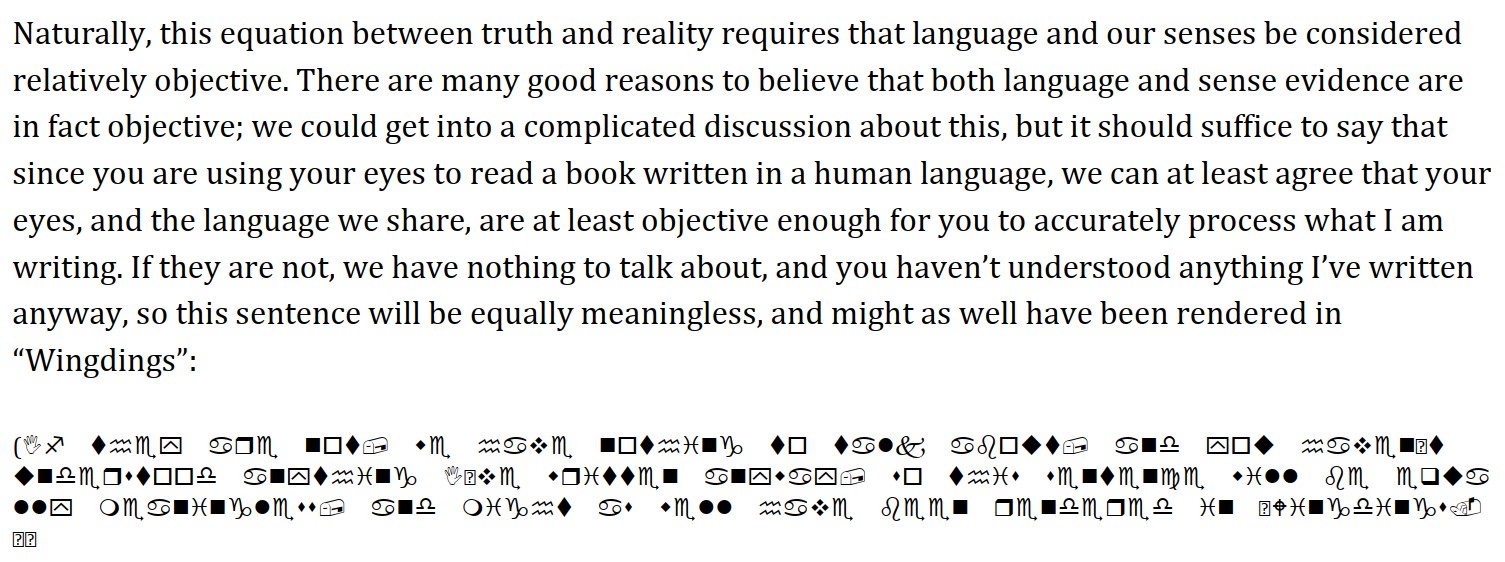
This is a true gem. From a writer's perspective, this is a sentence one finds once every 100 books he reads, and in this case it's a sentence meant to infinitely confuse the reader. I can imagine trying out a nut and a bolt; if they fit, they conform, but the manufacturer has to have material tolerances in mind, so they're never a perfect match but it works. How do we measure conformity of statements to reality? How do we even begin to estimate whether words fit things, especially when both are defined by someone like Stefan? This sentence is a marvel on par with Wonders of the World, it's simply the work of a master but what comes next is even better, it's beyond description, which is why I included a screenshot.
In a following paragraph (p. 24), Stefan realizes that the above sentence of his I quoted needs justification, so he does it by essentially saying, "Every reader should instinctively understand when statements conform to objective reality; for those who don't, my work might as well be written in Wingdings font, so here's a Wingdings font sentence" (click the image for a 263 KB, 1505x562px version):
At this point, I felt emotionally drained, so I decided to take a break and reconsider the work I'd done so far until I come up with a workable system to use for the rest of the book. Keep in mind, Stefan considers UPBARPSE his seminal work, one that should set out a framework for secular ethics for the entire world. It's meant to be serious business. Just look at that mess.
After the first 25 pages, it's quite clear to me that Stefan Molyneux treats UPBARPSE readers with disdain. There's a certain suspension of disbelief that a reader should have to enjoy a work of fiction but also a certain dose of skepticism if the work is to be treated seriously. In my mind, the entire purpose of fantastic flourishes in UPBARPSE is to put the reader's mind in "fiction mode", and then slam it with vile constructions such as the Wingdings section seen above that would have no effect on a skeptical reader, all the while claiming it's UPB. Why are you reeling, bro, are you afraid of UPB written out in Wingdings?
More than anything else, the Wingdings section proves to me that Stefan sees UPBARPSE as a joke. Therefore, I decided to agree with him on this point and also treat UPBARPSE as an elaborate joke by a guy who thinks he can argue, reason, and write. This change in attitude refreshed my enthusiasm and I was once again willing to comb through UPBARPSE, this time in search for laughable parts. Keep in mind, this is what Stefan does to his critics already, mocking them through snickers while feigning a serious discussion.
Defined by TheFreeDictionary.com as "a partly stifled laugh," Stefan uses snickers as a way to humiliate any critic who takes the UPBARPSE bait without explicitly stating his disdain, which allows Stefan to hide behind the veneer of being a jolly old fellow who likes laughing and is so intellectually superior that he doesn't even have to speak. You probably figured out by now that UPBARPSE is intentionally designed in such a way that any critic taking it seriously opens himself up to Stefan's snickering; by now I am wholly convinced UPBARPSE has no other function.
Stefan's snickering appears completely spontaneous and random but it's actually intentional and meant to either provoke the critic into laughing at himself or enrage him into lashing out, at which point Stefan can claim he's being threatened, slandered etc., all the while using that opportunity to create more inflammatory content for his channel and build up his reputation as a formidable, inviolate philosopher. It's like if Stefan had a recording of a sitcom laugh track and, every time you tried to talk about a topic that's important to you, Stefan played the laugh to confuse, disorient, and provoke you without doing anything, claiming that you're going crazy when you protest it. I'll discuss defense against this at the very end.
More data popped up confirming that Stefan intentionally baits others into attacking him so he can unleash the full force of snickering. In his February 1, 2019 video titled "David Gordon: The Molyneux Problem - Rebutted!", Stefan does nothing but laugh while reading a critic's article, and when Youtubers use his favorite quip "that's not an argument," Stefan comments the following:
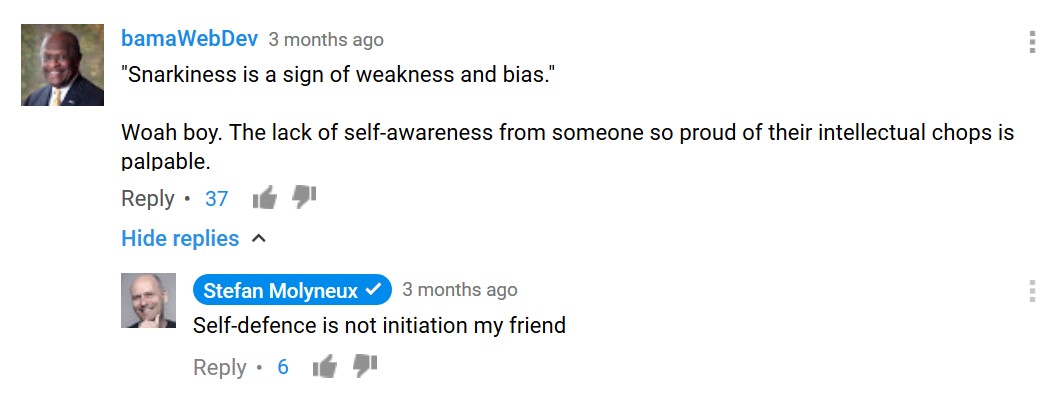
For more great examples of Stefan's snickering at a critic, see Stefan's video "STEFAN MOLYNEUX IS A THIEF & INITIATES THE USE OF FORCE! 'Rationality Rules' is NOT hysterical!" published on Stefan's Youtube channel April 5, 2019, a Matryoshka doll of video clips where Stefan examines a critic's examination of his videos, often using underhanded insults and mocking him (re-read the title). The parts where Stefan snickers at his critic are given with timestamps in brackets so you can hear it in action:
"(snicker) Here it is, 'universably', I'm sorry, I won't keep pointing it out, just mentioning (...)" (6m55s)
"(...) so, I have a book called 'Universally Preferable Behavior' (snicker), sorry, was almost gonna say 'universably' (...)" (23m20s)
"(...) no one ever actually gets to the moral theory (snicker), just you know (...)" (32m08s)
" (...) because I only have stomach for this kind of stuff (snicker) for so much (...)" (32m55s)
"(...) if you want to get to the top of the leaderboard in Fortnite, you have to play Fortnite (snicker) (...)" (34m15s)
"(snicker) I just wanna point out (...)" (37m27s)
"(snicker) I'm sorry, I shouldn't laugh (...)" (37m52s)
"I respect the work that he put in, not the conclusions (snicker) (...)" (40m07s)
"The moon is not made of green cheese, therefore you ought to correct people on it, right? (snicker)" (41m40s)
"To not believe the moon is made of green cheese, that's the definition of morality now (snicker)? Come on." (43m25s)
"(snicker) OK." (44m23s)
"Why include that if you're just going to go (snicker) to the book?" (46m53s)
"I don't know what this means, this guy spent thousands of hours and years and years of his life correcting everyone in the known universe and then he says it's not better to be correct? (snicker)" (47m28s)
"I mean (snicker), I don't know what to say." (49m31s)
"(snicker) I mean, it's implicit (...)" (49m40s)
"Did he really just (snicker) (...)" (50m53s)
"So, it's not something he has to assume (snicker) (...)" (51m55s)
"(snicker)" (52m21s)
"He's not having any luck (snicker) (...)" (1h09m12s)
"(...) so, where was his concern for my well-being? (snicker) " (1h13m35s)
"(...) and it also is true. (snicker)" (1h16m49s)
"Well, you know (snicker) (...)" (1h17m20s)
"Any time I'm wrong, it's also hypothetical (snicker) (...)" (1h17m48s)
"OK, maybe I didn't help him as much as I thought (snicker) (...)" (1h18m25s)
"(...) isn't that saying that it's false (snicker)?" (1h18m46s)
"(...) (snicker) what's that mean? " (1h19m25s)
"I might know a little bit here and there (snicker) (...)" (1h20m13s)
"(snicker)" (1h20m33s)
"The moon is square (snicker), the moon is where Minecraft is (snicker) (...)" (1h20m40s)
"Oh, I'm sorry (snicker) (...)" (1h22m09s)
One could argue that snickering is simply Stefan's way to breathe some merriment in what is otherwise a serious topic, but nothing else corroborates that argument. In all the above cases of snickering, Stefan was doing so at his critic, not the topic at hand or himself. Also, at the very end of the "Rationality Rules" video, Stefan turns completely serious for some 15 minutes, which means he can willingly control his snickering and it's just a poor man's debating tactic meant to score some cheap ego points.
The main lesson here is that tone matters. We instinctively pick up cues that reveal other person's disposition, including partly stifled laughter i.e. snickers. When listening to people, pay attention to their tone of voice, and you'll see what they're thinking of you. In this case, Stefan obviously thinks his critic is an idiot, but he won't say it because his listeners would object to the wording; instead, Stefan uses snickers to convey that meaning and implant it in our subconscious. So, let's treat Stefan to his own medicine, shall we? The following section contains UPBARPSE quotes, with page references so you can read them in context.
"(...) we are immune to gravity, and then we fly on the back of an elephant, and then we can walk through walls." (p. 24)
"The fact that seagulls do not arbitrarily turn into anvils — or vice versa — is the root of our capacity to accurately judge the statement: 'That is a seagull.'” (p. 24)
"Clearly, if balls randomly went in any and every direction — and magically transformed into flocks of doves to boot — we would be utterly unable to predict their behaviour." (p. 26)
"If I submit wonderful plans for a house constructed entirely of soap bubbles, I will never get the commission, since such a 'house' could never stand." (p. 27)
"If erroneous mathematical calculations result in a strength of minus 50 tons per square foot at any part of the bridge, then it certainly will not stand." (p. 27)
"If my economic theory requires that prices go up and down simultaneously, then it cannot be valid, since this is impossible." (p. 27)
"If he wishes to be moral, he must become a baseball player — not because becoming a baseball player is moral, but rather because obeying his father is moral." (p. 30)
"If you want to live, it is universally preferable that you refrain from eating a handful of arsenic." (p. 32)
"Likewise, if a man wants to cure an infection, he should take antibiotics rather than perform an Aztec rain dance." (p. 34)
"If I tell you that I like chocolate ice cream, and you tell me that you like vanilla, it is impossible to 'prove' that vanilla is objectively better than chocolate." (p. 35)
"It is impossible to prove that I dreamt of an elephant last night." (p. 37)
"I cannot submit a scientific paper written in my own personal language, claiming that it has been refereed by my psychic goldfish, and expect to be taken seriously." (p. 37)
"A theory of gravity proves that if you push a man off a cliff, he will fall." (p. 38)
Let's take a break here. Stefan has a habit of arguing that denying UPB actually confirms its existence, which I don't find reasonable or self-evident at all. It's a circular statement that snuffs out all debate and loops back to itself for confirmation. I can claim I'm a 20-foot giant and that people denying it are doing so out of jealousy, with their measuring instruments designed to fool me, which means I am a gorgeous 20-foot giant. See? To think one's ideas impervious to criticism is utter delusion. To quote Stefan on this:
"(...) if I argue against the proposition that universally preferable behaviour is valid, I have already shown my preference for truth over falsehood — as well as a preference for correcting those who speak falsely." (p. 40)
We discuss ideas because nobody knows everything and it's only through a reasonable, fair, and respectful debate that we arrive at any kind of revelation. All scientific progress is made when long-standing ideas are examined and criticized; all interesting ideas are exposed when we allow for some degree of criticism. Therefore, we should assume any idea could be right, wrong, or any degree in between because that's what leads to the greatest amount of discovery; we should take turns giving our input and give enough time to the other side as to avoid pressuring them into Zeitnot statements. If one side automatically assumes his position is correct and any criticism of it as confirmation of his position, debate is impossible.
In this case, I don't think UPB is invalid, but simply that Stefan isn't the intellectual or moral authority to tell us what it is or even a good enough writer to formulate a fair or interesting enough stance on it, not to mention the incessant snickering. In Stefan's hands, UPB is just a bludgeon for splitting heads; no matter how much he says it's a universally preferable hair brush, I won't be letting him come near me wielding it because I don't trust him. Let's carry on with snickering at him.
"On the other hand, there are other preferences, such as rape and murder, which clearly are inflicted on others." (p. 40)
"If I rape, steal or kill, no thunderbolt strikes me down." (p. 43)
"The theory of relativity cannot argue that the speed of light is both constant and not constant at the same time, or that it is 186,000 miles per second, five fathoms in depth and also green in colour." (p. 43)
"Let’s say that you and I are having a debate about the existence of God. After I put forth my arguments, you clap your hands over your ears, singing out that God is telling you that He exists, and therefore all of my arguments mean nothing." (p. 48)
"If you and I are both standing at the top of a cliff, and I turn to you and say, 'Stand in front of me, so I can push you off the cliff,' what would your response be?" (p. 50)
"If I live on a high mountaintop 5,000 miles away from you, and send you an e-mail telling you that if you ever walk in front of my house, I am going to shoot you, it is relatively easy for you to avoid this situation." (p. 51)
"A scientist captured by cannibals may pretend to be a witch-doctor in order to escape — this does not mean that we must dismiss the scientific method as entirely invalid." (p. 56)
"If I propose the moral rule: 'thou shalt defy gravity,' then clearly morality becomes impossible (...)" (p. 65)
"Raping someone is a positive action that must be initiated, executed, and then completed." (p. 66)
"All other things being equal, a rock cannot fall both up and down at the same time, and a valid theory cannot predict that one rock will fall up, while another rock will fall down" (p. 66)
"With that in mind, let us continue our examination of rape." (p. 67)
"Once again, the UPB framework comes to the rescue." (p. 68)
"Perhaps rape is akin to a merely personal preference." (p. 69)
"Of course, few rapists are philosophers (...)" (p. 71)
"Noon is definitely not night, and midnight is definitely not daytime (...)" (p. 78)
"(...) akin to saying that pouring water into a swimming pool both fills it and empties it at the same time." (p. 81)
By now, it's clearly seen that Stefan's reasoning skills are poor at best. His writing is droll, repetitive, and contains exactly zero novel ideas that would make one re-read, let alone cite UPBARPSE to others. It's like cracking open a walnut and finding its insides rotten — a disappointing waste of time, an offense to senses, and a danger to the body if ingested. He uses the most inflammatory verbiage imaginable and is obsessed with rape because it gets people incensed.
I got the suspicion that he knows what he's doing and that he intentionally wrote UPBARPSE to contain tautologies, so I went to TheFreeDictionary.com to look up "tautology" and got: "Needless repetition of the same sense in different words; redundancy, an instance of such repetition; a statement composed of simpler statements in such a way that it is logically true whether the simpler statements are factually true or false; for example, the statement 'Either it will rain tomorrow or it will not rain tomorrow'."
Everything Stefan has presented so far has been mired in tautologies, sentences such as: "(...) a rock cannot fall both up and down at the same time," which are meant to elicit agreement from the reader but otherwise hold no weight; it's just word filler. Let's carry on by digging up tautologies and laughable parts from UPBARPSE. There are still ~50 pages left, let's find some gems.
"Clearly, fraud requires that one person not be engaged in fraud." (p. 82)
"Similarly, if a man obtains a hundred dollars from us by lying, we may justly lie to him to get it back." (p. 84)
"If I voluntarily enter into a contract with you wherein I promise to pay your bills for a year, I have not signed myself into slavery (...) We do not sign a contract with a restaurateur when we go to eat a meal in his restaurant; it is simply understood that we will pay before we leave (...) I also have never signed a contract promising not to rape a woman (...) (p. 88)
"Since children cannot feed themselves, earn a living or live independently, they are the moral equivalent of kidnap victims (...)" (p. 89)
"Parents who starve a child to death are clearly guilty of murder (...) Can I justly shoot someone who eats a piece of fish? (...) A scientist cannot validly say that his theory of gravity only applies to pink rocks." (p. 90)
"It is clear that sharks do not have the capacity to refrain from killing fish, since they are basically eating machines with fins." (p. 91 )
"It is a true belief that the Sahara Desert is in North Africa; it is a false belief that the Sahara is in Scotland (...) If I say that I believe that a square circle exists, then I am making an explicitly self-contradictory statement, which disproves itself (...) If I say: “A square circle exists,” I am asserting that which is clearly impossible within this universe." (p. 97)
"Square circles, gods and other self-contradictory concepts cannot hide [in the null zone], any more than they can hide in the wet dreams of leprechauns." (p. 98)
"If nothing can be true or false – even that statement – then no statements whatsoever can be made about anything." (p. 99)
"In this section, however, it is officially permissible for you to begin to be truly shocked (...) Soldiers, of course, wear costumes that are different from the average citizen." (p. 100)
"First of all, leprechauns do not exist (...) If I say that a square circle has the right to steal, I am merely saying that that which cannot exist has the right to do that which is self-contradictory (...)" (p. 101)
"I ask these rhetorical questions because they are in fact deadly serious. Clearly, a military costume does not change the nature of a human being, any more than a haircut turns him into a duck, a concept, or a god." (p. 102)
"Clearly, we understand that I cannot through my opinion release you from the restraints of gravity, any more than my opinion that “2+2=5” makes it true (...) wearing a Hawaiian shirt to Iceland does not make Reykjavik any warmer." (p. 102)
"If a man holds a knife to a woman’s throat while having sex with her, that is by any definition an act of rape. He cannot say that the sex is consensual, while at the same time threatening her with injury or death if she refuses to have sex with him. If the sex is voluntary, then the knife is completely unnecessary. If the man feels the need for a knife, then clearly the sex is not voluntary." (p. 103)
"The 'null zone' is the lair of the beast we hunt (...) Clearly, when Bob wakes up in the morning, before his shift, he cannot go to his neighbour’s house and demand money at the point of a gun, no matter who tells him that it’s all right." (p. 104)
"If I force a woman to marry a man I have chosen for her, then clearly I believe that I have infinitely better judgment about the suitability of a husband for her than she does." (p. 106)
"Either I am capable of making competent decisions, or I am not (...) Clearly, I cannot sign a contract on your behalf (...)" (p. 107)
"If there is no evil, governments are unnecessary. If evil exists, the governments are far too dangerous to be allowed to exist." (p. 109 )
"Stealing, as we have proven, is evil." (p. 113)
"Thus if you think that 'majority rule' sounds like a reasonable moral proposition, and a perfectly valid moral theory, then I am afraid you’re going to have to go back to the beginning of this book and start again! ☺" (p. 116) [Dejan's note: I did not inject the smiley face, that's Stefan's writing]
"The sun rose trailing the chains of a supernatural chariot; the moon was a cold and lonely brother of the sun." (p. 119)
"We can either choose virtue or compulsion." (p. 120)
"Children do not have to be bullied into eating candy, playing tag, or understanding that two plus two is four." (p. 122)
"If I write a check that is 'certified' by a bank that does not exist, then clearly my check is by definition invalid." (p. 123)
Whew, I made it. Reading through UPBARPSE and formulating this review took me about 30 hours, including listening and transcribing the video with snickers I mentioned above. Overall, I'm happy and consider my time well spent, because what would have otherwise been spent on grinding Skyrim went into something productive, in this case analyzing a faux-losopher and his elaborate web of false premises.
I believe I have thoroughly disassembled UPBARPSE to reveal that Stefan:
UPB is an irrelevant topic, used by Stefan solely to endlessly bait critics. UPBARPSE is a red herring meant to lead critics around in circles while Stefan snickers at them as they struggle to form an argument against UPB, which also explains why the book is forever stuck on version 1.0; it does its job the way it's written, and it's not meant to ever be updated. Stefan's end goal is building up a reputation as a philosopher when he's nothing more than a sophist, a fake debater, thinker, and intellectual who relishes confusing and insulting others under the guise of debating them. Stefan doesn't care about ethics, philosophy, or even having just a plain debate; he only cares about winning at any cost, which reveals his frail ego and his mental immaturity.
I mentioned snickering, so I'd like to reveal how to defend against it. When I was a kid, my older brother used the exact same tactic as Stefan, which would partly explain my motivation for writing this analysis. In essence, my older brother would engage in a debate with me by repeating back what I said with a guffaw. That's it, just a mocking repetition of what I said to inflame me into losing my temper, because how else does he win?
Realize that those who can't win a debate make it personal, and mocking the other side is nothing more than a desperate attempt at winning. Point out the mocking by stating, "You are mocking me," observe the mocker's reaction, and, if it's one of glee and pride, refuse to carry on the debate until you receive a sincere apology. Do not be bullied verbally. Do not yield easy wins, no matter how insignificant they seem at the moment because it all adds up and produces a feeling of inferiority in you. That's it, simply point out the mocking and demand an apology. If you don't receive it, don't debate anything with that person. If it's your family member and you must discuss something, always make sure everything is in writing and that you have a hefty archive of lies and deceit that is in a secure, private location that the mocker doesn't know about. If your situation goes to court, you want to make sure the verbal gymnastics are amply documented.
If you want to use this text to criticize Stefan and other mental midgets like him, now you know how. Do not discuss UPB. Instead, pick a single quote and ask about it in a bona fide way. For example, "Stefan, you say that 'If I rape, steal or kill, no thunderbolt strikes me down' on page 43 of UPBARPSE. Does that mean rape, theft and murder grant immunity to thunderbolts?" Expose the sophist's words and let him cut you off, get mad, start babbling, copyright claim your channel etc. As he lashes out, he'll expose himself for what he is, and the exact same tactic he so carefully laid out for his critics will be used against him. Checkmate, Stefan.